Lead time for change measures the elapsed time between producing a software change and making it available to live customers. It is a DORA delivery-velocity metric, alongside deployment frequency, while change failure rate and time to restore service indicate recovery from failure. section 9.1
Calculating it requires joining source-code version-control events with continuous-deployment events. A standardized event model makes those signals available for metric processing across different delivery systems. section 9.2.1 section 9.2.2
A lead-time measurement pipeline typically performs these steps:
- Collect events from source-control, deployment, and other delivery systems. section 9.2.1 section 9.2.2
- Wrap non-CloudEvent data with CloudEvents SDKs before it enters the system. section 9.2.2
- Map incoming CloudEvents to CDEvents, then process the standardized data to calculate metric values. section 9.2.1 section 9.2.2
- Persist incoming data and calculations, then expose results through a dashboard. section 9.2.2
Event-based calculation
A source-code version event records when a change is produced, while a deployment event records when that change reaches a live environment. Combining the two event streams supplies the timestamps needed to calculate lead time for change. section 9.2.1
Figure 9.3 Lead time for change data sources
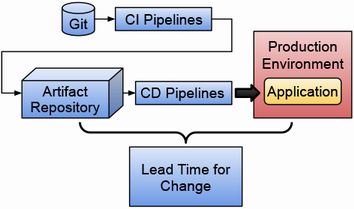
Use the data-source diagram to trace which delivery-system events contribute to lead time for change. section 9.1





