liveBook · Manning

Leaf switch

As explained in Acing the CCNA Exam: Volume 2 Advanced Networking and Security

A leaf switch is a switch in the endpoint-facing layer of a spine-leaf data-center topology that connects to hosts and spine switches.

A leaf switch forms the endpoint-facing layer of a spine-leaf data-center topology. Servers connect to leaf switches, and each leaf connects to every spine switch. section 15.3.2

Key operational characteristics include:

  • Avoids leaf-to-leaf connections; traffic between different leaf switches traverses one spine switch. section 15.3.2
  • Provides consistent, predictable server-to-server latency because leaf switches are equally distant from one another. section 15.3.2
  • Scales by adding a leaf switch and connecting it to every spine switch. section 15.3.2
  • Uses the term border leaf for a leaf switch connected to the WAN, internet, or another external network. section 15.3.2
Figure 15.9 Spine-leaf architecture, a two-tier LAN architecture commonly used in modern data center networks
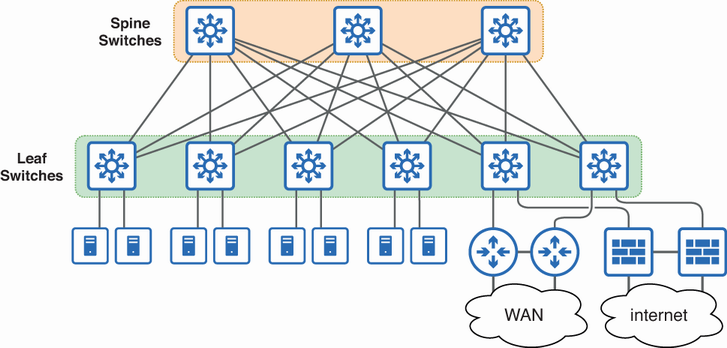
Use the topology figure to trace host-to-host paths through leaf and spine layers. section 15.3.2

How Acing the CCNA Exam: Volume 2 Advanced Networking and Security covers it

How deep it goes
Explains placement, interconnection rules, latency behavior, border-leaf terminology, and scaling, without configuration procedures.
Examples
Uses host-to-host paths, same-leaf exceptions, border-leaf links, and adding leaves across all spine switches.
What you can do after
Evaluate leaf-switch placement, expected hop counts, latency consistency, and straightforward fabric expansion.
How it connects
Ties leaf switches to spine switches, spine-leaf architecture, border leaves, servers, and east-west traffic.

Related concepts

This explainer was generated by Manning's knowledge graph from the text of Acing the CCNA Exam: Volume 2 Advanced Networking and Security. The section links point to the parts of the book it draws on.