Spine-leaf architecture is a two-layer data-center topology designed for high-bandwidth, low, predictable latency between servers. It addresses east–west traffic better than traditional three-tier designs, which can create bottlenecks and variable server-to-server latency. section 15.3.2 section 15.5
Use these structural rules to identify a spine-leaf network:
- Servers connect to leaf switches; every leaf connects to every spine. section 15.3.2
- Leaf switches do not connect to other leaf switches, and spine switches do not connect to other spine switches. section 15.3.2
- A server-to-server path normally crosses a leaf, one spine, and another leaf, producing a consistent hop count and predictable latency. section 15.3.2
- Scale by adding a leaf switch and connecting it to every spine switch; a leaf serving external networks is a border leaf. section 15.3.2
Typical server path
A packet from one server to another normally travels from the source server to its leaf switch, through one spine switch, to the destination leaf, and then to the destination server. Servers on the same leaf avoid the spine and therefore have shorter latency. section 15.3.2
Figure 15.9 Spine-leaf architecture, a two-tier LAN architecture commonly used in modern data center networks
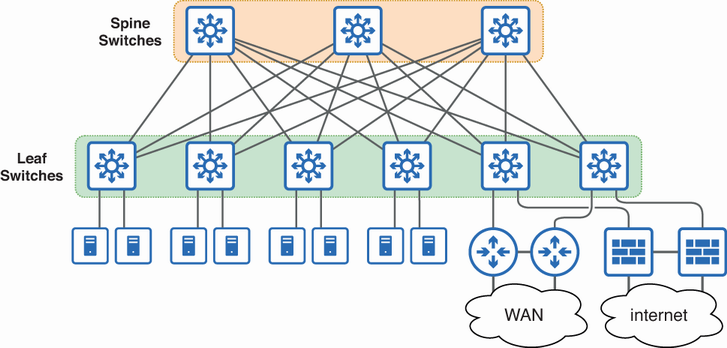
Use the topology figure to distinguish the spine and leaf layers and verify their all-to-all interconnection. section 15.3.2
