liveBook · Manning

Spine switch

As explained in Acing the CCNA Exam: Volume 2 Advanced Networking and Security

A spine switch is a switch in the upper layer of a spine-leaf data-center topology that connects to leaf switches.

A spine switch is an upper-layer switch in a spine-leaf data-center topology. It connects to every leaf switch and provides the intermediate hop between servers attached to different leaf switches. section 15.3.2

Key operational characteristics include:

  • Every leaf switch connects to every spine switch, while spine switches do not connect to one another. section 15.3.2
  • Traffic between servers on different leaf switches follows a leaf–spine–leaf path, producing a consistent hop count and predictable latency. section 15.5
  • The topology scales by adding leaf switches and connecting each new leaf to every spine switch. section 15.3.2
Figure 15.9 Spine-leaf architecture, a two-tier LAN architecture commonly used in modern data center networks
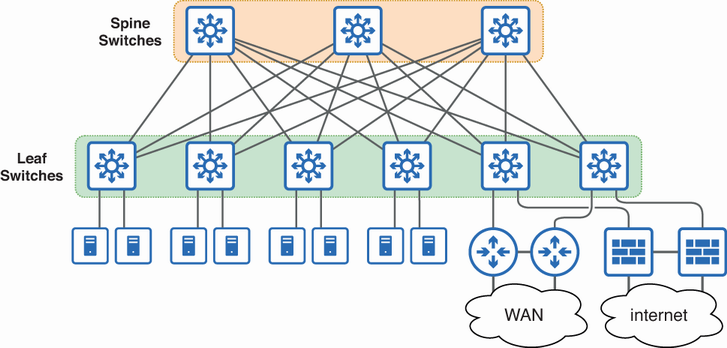
Use the topology figure to visualize spine switches between fully connected leaf-switch layers. section 15.3.2

How Acing the CCNA Exam: Volume 2 Advanced Networking and Security covers it

How deep it goes
Defines placement, connectivity, hop behavior, latency, and scaling, but does not cover device configuration or verification commands.
Examples
Illustrates server-to-server paths through leaf and spine switches and depicts the topology in a figure.
What you can do after
Evaluate spine-leaf diagrams, predict server path length, and identify scaling and connectivity rules.
How it connects
Connects spine switches with spine-leaf architecture, leaf switches, east–west traffic, and predictable latency.

Related concepts

This explainer was generated by Manning's knowledge graph from the text of Acing the CCNA Exam: Volume 2 Advanced Networking and Security. The section links point to the parts of the book it draws on.