Lightweight Directory Access Protocol (LDAP) is a protocol for querying directory services such as Microsoft Entra ID or OpenLDAP. Directory services centrally store information about users and other resources, allowing applications such as Airflow to verify credentials without maintaining separate user accounts. section 16.3 section 16.3.1
LDAP is suited to directory workloads dominated by frequent reads and relatively infrequent changes. Data is organized as a directory information tree (DIT); each entry contains attribute-value pairs and has a unique distinguished name (DN). Common structure uses domain components (dc), organizational units (ou), and common names (cn). section 16.3.1
Core LDAP operations include:
- Bind authenticates as a user after the initial anonymous connection. section 16.3.1
- Search returns entries matching criteria; for example, ldapsearch -b "dc=apacheairflow,dc=com" "(uid=bsmith)". section 16.3.1
- Add, modify, delete, compare, modify DN, abandon, extended, and unbind manage entries, attributes, requests, and connections. section 16.3.1
Airflow LDAP authentication
Configure Airflow to use FAB authentication, enable LDAP registration, select a default role, and provide the directory endpoint and search settings. A representative configuration sets AUTH_TYPE = AUTH_LDAP, AUTH_USER_REGISTRATION = True, AUTH_USER_REGISTRATION_ROLE = "User", AUTH_LDAP_SERVER = "ldap://openldap:389", AUTH_LDAP_SEARCH = "dc=apacheairflow,dc=com", and AUTH_LDAP_UID_FIELD = "uid". After login, FAB searches the directory for the submitted username and password and creates the Airflow user when registration is enabled. section 16.3.2
Figure 16.8 Users are stored in a directory service such as Entra ID or OpenLDAP, which can be accessed with LDAP. This way, a user is created only once and can connect to all applications.
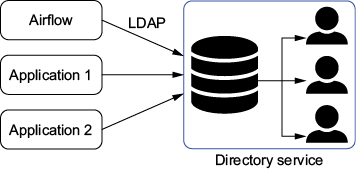
A centralized directory lets one user identity connect to multiple applications instead of being created separately in each application. section 16.3


