Link prediction forecasts missing, future, or unobserved connections between nodes. It can estimate whether a link exists, assign an existence probability, or predict a relationship type. section 9.2.2 section 10.2
Graphs are often incomplete because existing connections go unrecorded or hidden, while evolving networks continually create new edges. Predictions support recommendations, knowledge graph completion, drug-side-effect prediction, and interaction discovery. section 9.2.2
A practical link-prediction pipeline typically follows these stages:
- Represent entities and interactions as a graph, preserving dependencies that independent-data assumptions would ignore. section 9.1
- Featurize nodes or candidate node pairs with structural features or learned embeddings; reuse the same featurization during training and prediction. section 9.3.1 section 9.4
- Train a classifier or encoder-decoder model to distinguish existing from absent links, optionally predicting among relationship types. section 10.2 section 12.0
- Score candidate node pairs and validate predictions with metrics such as precision, recall, and F1-score. section 12.0 section 9.2.2
Movie recommendations
A heterogeneous graph represents users, movies, and user–movie ratings. A heterogeneous GNN learns user and movie embeddings, then a dot product scores candidate interactions; binary cross-entropy trains the link decoder. section 12.2 section 12.2.4
Drug repurposing
Treat drugs and diseases as nodes and potential therapeutic relationships as candidate links. Relationship features can support binary prediction of whether a treatment relationship exists. section 10.2
Figure 9.3 Typical link prediction flow. It has two phases. During the training phase, the graph is used as input, and the model is trained to determine whether a link exists. During the prediction phase, the model provides an output for each pair of nodes representing the target relationship to predict. It provides an existence probability for each.
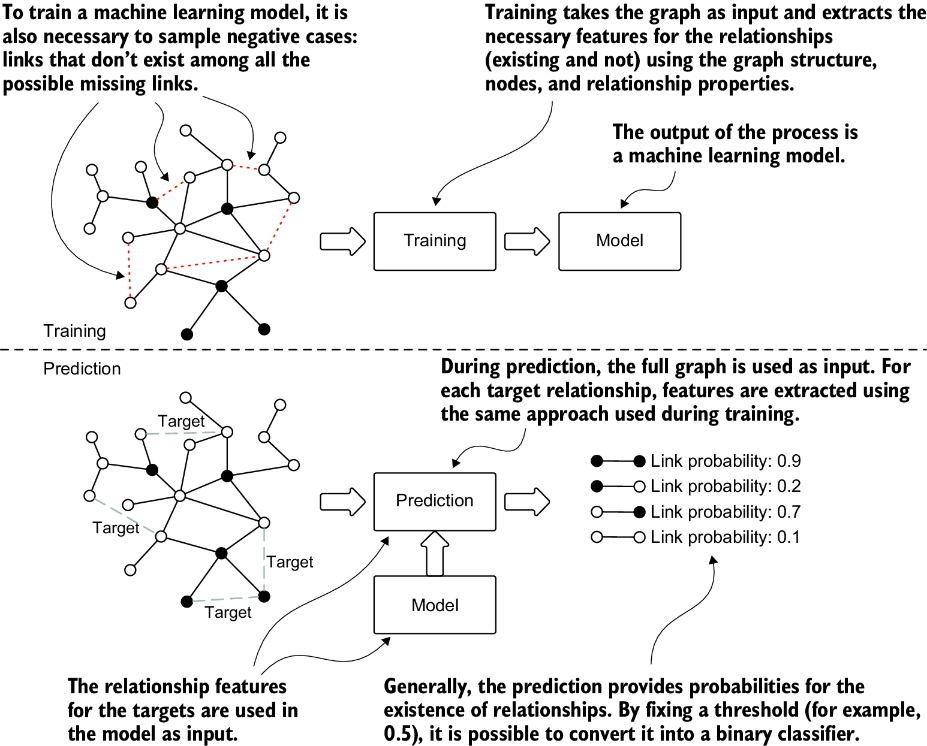
Follow the two-phase flow from graph-based training to existence probabilities for candidate node pairs. section 9.2.2


