liveBook · Manning

Link-state acknowledgment message

As explained in Acing the CCNA Exam: Volume 1 Fundamentals and Protocols

A link-state acknowledgment message is an OSPF message that confirms receipt of link-state updates.

A link-state acknowledgment (LSAck) message is an OSPF message that confirms receipt of a link-state update (LSU). During the Loading state, routers use LSR messages to request LSAs, LSU messages to send them, and LSAck messages to acknowledge those LSUs. section 18.3.1

Keep the message roles distinct:

Figure 18.9 The OSPF neighbor states: Down, Init, 2-Way, ExStart, Exchange, Loading, and Full. Routers that reach the 2-Way state are OSPF neighbors. Some routers remain in this state, and some proceed to establish a full adjacency.
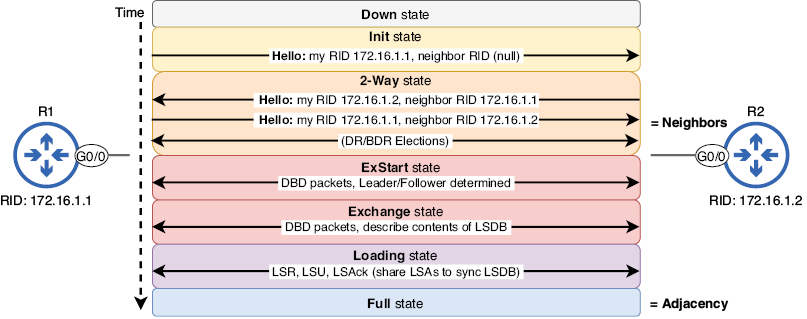
Use the OSPF neighbor-state diagram to place LSAck messages in the Loading state before routers reach Full adjacency. section 18.3.1

How Acing the CCNA Exam: Volume 1 Fundamentals and Protocols covers it

How deep it goes
Defines its acknowledgment role and places it in Loading, without detailing packet fields or retransmission behavior.
Examples
Uses the Loading-to-Full neighbor-state progression and distinguishes LSAs from the LSUs that carry them.
What it assumes
Assumes basic OSPF neighbor states and introduces the distinct roles of LSAs, LSUs, and LSRs.
What you can do after
Evaluate an OSPF neighbor-state sequence by identifying LSAck messages as confirmations of received LSUs.
How it connects
Connects LSAck messages with OSPF, LSAs, LSUs, LSRs, LSDBs, and full adjacency.

Related concepts

This explainer was generated by Manning's knowledge graph from the text of Acing the CCNA Exam: Volume 1 Fundamentals and Protocols. The section links point to the parts of the book it draws on.