liveBook · Manning

Link-state request message

As explained in Acing the CCNA Exam: Volume 1 Fundamentals and Protocols

A link-state request message is an OSPF message that requests specific link-state advertisements from a neighbor.

A link-state request (LSR) message asks an OSPF neighbor for specific link-state advertisements (LSAs). It helps routers complete their link-state database synchronization after comparing database description messages. section 18.3.1

The exchange follows this sequence:

  • Routers exchange DBD messages in the Exchange state and learn which LSAs each neighbor has. section 18.3.1
  • During the Loading state, a router sends LSR messages for missing or specific LSAs; the neighbor returns them in LSU messages. section 18.3.1
  • After the needed LSAs are received and acknowledged, synchronized routers enter the Full state. section 18.3.1
Figure 18.9 The OSPF neighbor states: Down, Init, 2-Way, ExStart, Exchange, Loading, and Full. Routers that reach the 2-Way state are OSPF neighbors. Some routers remain in this state, and some proceed to establish a full adjacency.
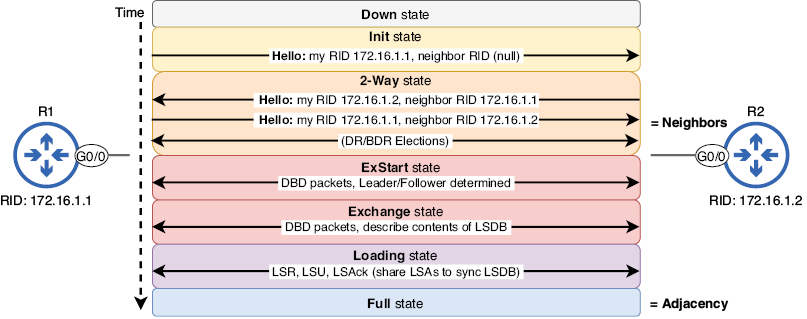
Use the OSPF neighbor-state sequence to place LSR messages between Exchange and Full. section 18.3.1

How Acing the CCNA Exam: Volume 1 Fundamentals and Protocols covers it

How deep it goes
Explains the message’s purpose and exchange sequence but does not detail its packet fields or encoding.
Examples
Uses the OSPF neighbor-state progression from Exchange through Loading to Full as the concrete synchronization scenario.
What it assumes
Assumes OSPF neighbor states and LSDB terminology while defining LSAs and distinguishing LSU envelopes from their contents.
What you can do after
Evaluate where LSR messages belong in OSPF adjacency formation and distinguish requested LSAs from carrying LSU messages.
How it connects
Connects LSR messages with OSPF neighbors, LSDBs, DBD messages, LSAs, LSU messages, and LSAcknowledgment messages.

Related concepts

This explainer was generated by Manning's knowledge graph from the text of Acing the CCNA Exam: Volume 1 Fundamentals and Protocols. The section links point to the parts of the book it draws on.