liveBook · Manning

Link-state routing protocol

As explained in Acing the CCNA Exam: Volume 1 Fundamentals and Protocols

Link-state routing builds a topology map of the network and calculates routes using that map.

A link-state routing protocol builds a connectivity map of the network, then uses that map to calculate routes to destination networks. This differs from distance-vector routing, where a router learns only a destination, metric, and next-hop router from neighbors. section 17.2.1 section 17.5

Key characteristics include:

  • Operates as an interior gateway protocol within a single autonomous system. section 17.5
  • Uses network-wide connectivity information rather than relying only on neighbor reports. section 17.2.1 section 17.5
  • Includes OSPF and IS-IS among the link-state IGPs. section 17.5
  • Supports route calculation before routes are considered for routing-table installation. section 17.5
Figure 17.9 R1 builds a connectivity map of the network and uses it to calculate a route to LAN A.
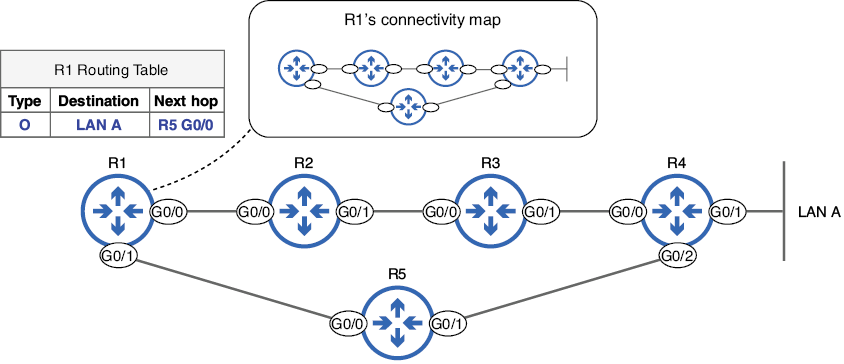
The network diagram shows a router building a connectivity map and using it to calculate a route to LAN A. section 17.2.1

How Acing the CCNA Exam: Volume 1 Fundamentals and Protocols covers it

How deep it goes
Explains the connectivity-map principle and contrasts it with neighbor-only knowledge, but does not detail a specific algorithm.
Examples
Uses a connectivity-map diagram showing R1 calculating a route to LAN A, and names OSPF and IS-IS as examples.
What you can do after
Evaluate whether a routing protocol uses a complete connectivity map or neighbor-provided destination information.
How it connects
Connects link-state routing with dynamic routing, IGPs, OSPF, IS-IS, routing tables, metrics, and route selection.

Related concepts

This explainer was generated by Manning's knowledge graph from the text of Acing the CCNA Exam: Volume 1 Fundamentals and Protocols. The section links point to the parts of the book it draws on.