An LLM application is a production software system that uses a large language model to process inputs and generate outputs. It combines established ML infrastructure with LLM-specific components and operational controls. Nondeterministic responses, multistep reasoning, prompt sensitivity, safety risks, observability, and token costs require adapted testing and monitoring rather than a complete replacement of traditional MLOps. section 12.0 section 13.0
A deployable LLM application typically manages:
- Application infrastructure: containers, load balancers, autoscaling, Kubernetes, deployment automation, and CI/CD. section 12.1 section 12.1.2
- Prompt artifacts: system prompts, user templates, few-shot examples, reasoning templates, versioning, and tests. section 12.1.2 section 13.0
- Model configuration: context and output token limits, sampling parameters, model selection, retries, and timeouts. section 12.1.2
- Retrieval assets: document preprocessing, chunking, embeddings, vector indexes, metadata schemas, retrieval parameters, and semantic search. section 12.1.2 section 1.4.2
- Quality and risk controls: semantic evaluation, observability, cost tracking, safety guardrails, governance, and adversarial testing. section 13.0 section 13.3
Documentation assistant
DakkaBot applies Retrieval-Augmented Generation to company documentation. A build-time pipeline ingests and embeds documents into a vector database; query time embeds a user question, retrieves relevant chunks, augments a prompt, and generates an answer. Production hardening adds observability, semantic evaluation, cost optimization, and safety guardrails. section 1.4.2 section 12.2.1
Figure 12.5 Build-time setup (top) ingests documents into a vector database and configures the LLM. Query-time flow (middle) handles user questions through embedding, retrieval, augmentation, and generation. Implementation requires three lines of LangChain code.
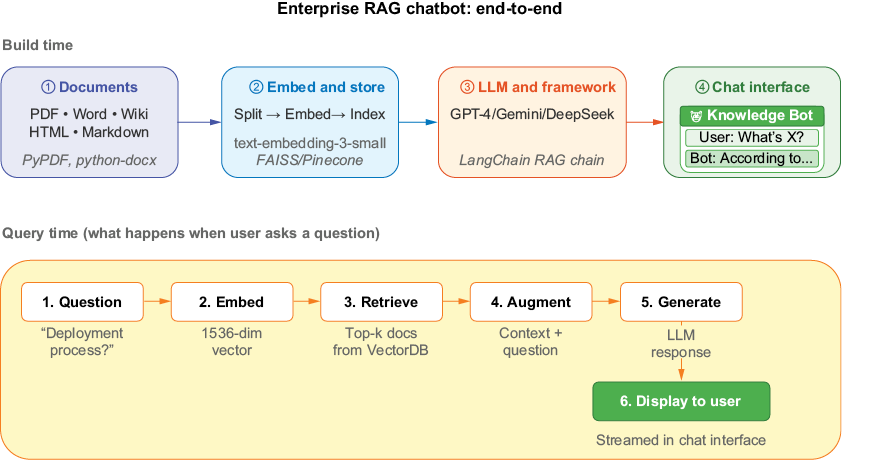
Trace the application’s build-time ingestion and query-time embedding, retrieval, augmentation, and generation flow. section 12.2.1

