An LLM application puts a use-case-specific workflow around a large language model. It takes a request, assembles a prompt—often with information from other sources—and returns the model’s output to a user or another system. Summarization, search, and content generation are bounded applications: they produce an answer to a request rather than deciding independently what work to do next. section 1.1 section 1.2.2
Two common workflows show where the surrounding software matters:
- A summarization engine condenses long passages. Other systems can invoke it through a REST API and either use the summary immediately or store it. section 1.1.1
- A Q&A engine first ingests documents: it splits text into chunks and stores the chunks with embeddings in a vector store. For a question, it searches for relevant chunks and sends them with the question to the LLM. section 1.1.1
Figure 1.2 A Q&A engine implemented with RAG design. An LLM query engine stores domain-specific document information in a vector store. When an external system sends a query, it converts the natural language question into its embeddings (or vector) representation, retrieves the related documents from the vector store, and then gives the LLM the information it needs to craft a natural language response.
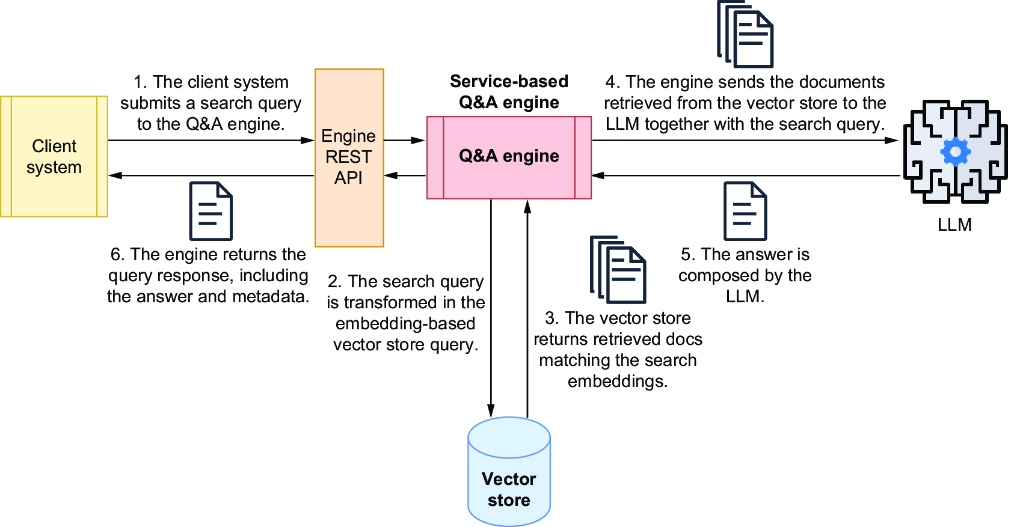
The Q&A diagram separates preparation of searchable domain documents from answering a question with retrieved context. That separation is useful when tracing where an answer’s supporting information came from. section 1.1.1
Prompts in an application are usually constructed and sent programmatically, not typed into a chat interface each time. A chain can pass one component’s completion to the next. A fixed workflow may include multiple steps without becoming an agent: an agent chooses actions and adapts later steps to intermediate results. section 2.1 section 1.1
Research summarization
A research summarization engine accepts a query, performs web searches, and compiles findings. Its implementation can grow from basic prompts into separate LangChain chains for searching and summarizing, then combine those sub-chains with LangChain Expression Language (LCEL), including parallel processing. section 4.0
Semantic SQL search
Another application generates a SQL similarity query from a prompt, runs a semantic search, and feeds the results to the LLM for synthesis. The prompt must be designed, implemented, and tested before it is integrated into an LCEL chain; the described targets are pgvector or SQL databases with ARRAY-like types. section 10.4.5

