liveBook · Manning

Locally optimal solution

As explained in Deep Learning with R, Third Edition

A local minimum is a point whose function value is no greater than the values at sufficiently nearby points.

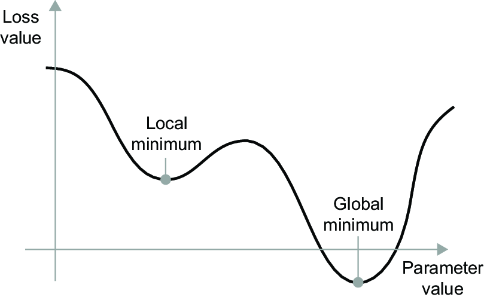
A locally optimal solution, or local minimum, is a point where the function value is no greater than values at sufficiently nearby points. In optimization, gradient descent can settle there even when a better global minimum exists. section 2.4.3

The learning rate affects whether stochastic gradient descent reaches a useful solution: a rate that is too small can become stuck in a local minimum, while one that is too large can jump to unpredictable locations. section 2.4.3

Figure 2.19 A local minimum and a global minimum
figure

Compare a local minimum with a global minimum on an illustrative loss curve. section 2.4.3

How Deep Learning with R, Third Edition covers it

How deep it goes
Defines local minima and connects them to learning-rate behavior, but stops short of formal analysis or high-dimensional optimization internals.
Examples
Uses one-dimensional loss curves, two-dimensional loss surfaces, and a visual comparison of local and global minima.
What you can do after
Diagnose how an excessively small or large learning rate can prevent useful progress during gradient descent.
How it connects
Connects local minima with stochastic gradient descent, learning rate, loss surfaces, and global minima.

Also explained in

Compare how 9 books explain locally optimal solution →

Related concepts

This explainer was generated by Manning's knowledge graph from the text of Deep Learning with R, Third Edition. The section links point to the parts of the book it draws on.







