liveBook · Manning

Locally optimal solution

As explained in Optimization Algorithms: AI techniques for design, planning, and control problems

A solution that is optimal relative to a neighborhood but may not be optimal over the entire feasible search space.

A locally optimal solution is at least as good as nearby alternatives, but may not be best across the entire feasible search space. For minimization, a local minimum has an objective value no greater than those in its neighborhood; a global minimum is best over the whole domain. section 1.3

Keep these distinctions in mind:

  • A strong local minimum is strictly better than every distinct point in a neighborhood; a weak local minimum is no worse than points in that neighborhood. section 1.3
  • Local search can stop at a local optimum instead of reaching the global one, especially on landscapes with multiple optima or plateaus. section 1.5 section 4.3.1
Figure 1.3 Feasible solutions fall within the constraints of the problem. A feasible search space may display a combination of global, strong local, and weak local minima.
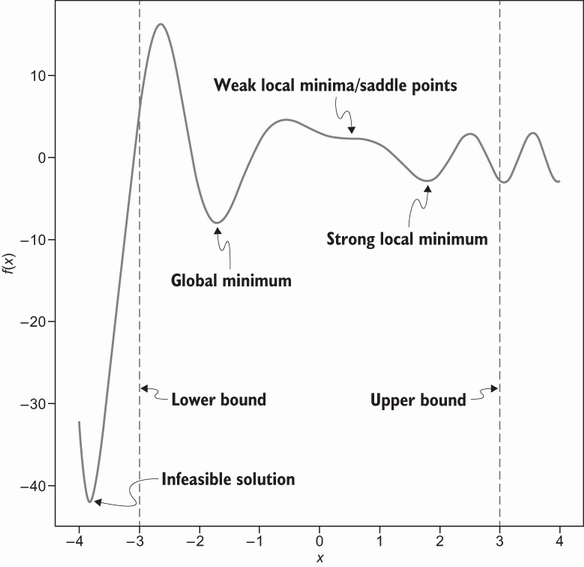
Compare global, strong local, and weak local minima within a feasible search space. section 1.3

Hill climbing

Hill climbing follows improving neighboring states and may stop at a local optimum. Examples include finding a route and solving the 8-puzzle; routing results can vary with the randomized starting route. section 4.3.1 section 4.4.1

How Optimization Algorithms: AI techniques for design, planning, and control problems covers it

How deep it goes
Defines strong and weak local minima through neighborhood comparisons and describes how hill climbing can get stuck.
Examples
Uses a search-landscape figure and hill-climbing examples in routing and the 8-puzzle.
What it assumes
Assumes an objective function and feasible search space while defining feasible, optimal, and near-optimal solutions.
What you can do after
Evaluate whether a candidate is only locally best and recognize why hill climbing may stop short of a global optimum.
How it connects
Connects local minima to global optima, feasible solutions, local search, and the exploration–exploitation trade-off.

Also explained in

Compare how 9 books explain locally optimal solution →

Related concepts

This explainer was generated by Manning's knowledge graph from the text of Optimization Algorithms: AI techniques for design, planning, and control problems. The section links point to the parts of the book it draws on.