A local area network (LAN) is a group of interconnected devices within a limited area, such as an office. It lets nearby clients, servers, printers, cameras, and other devices communicate through switches. section 2.0 section 2.2.2
Use these boundaries to distinguish a local network from surrounding networks:
- A switch connects devices within a LAN and usually provides many ports for end hosts. section 2.2.2
- A router sits at the edge of a LAN and connects it to other LANs or external networks such as the internet. section 2.2.3
- A WAN covers a larger geographic area, while a Layer 2 domain is a portion where hosts communicate without a router. section 2.0 section 6.1
- Multiple switches can belong to one LAN when directly connected; a router between switches makes them separate LANs. section 6.1
Local delivery versus routed delivery
PC1 at 192.168.1.11 with a /24 prefix recognizes 192.168.1.0–192.168.1.255 as its local network. To reach PC3 at 192.168.3.11, PC1 sends the frame to its default gateway’s MAC address, learned through ARP, rather than directly to PC3. section 10.1.1
Figure 6.1 Two offices with two switches in each office. In Office A each switch is a separate LAN because the switches are connected via a router. In Office B both switches are in the same LAN because they are directly connected to each other.
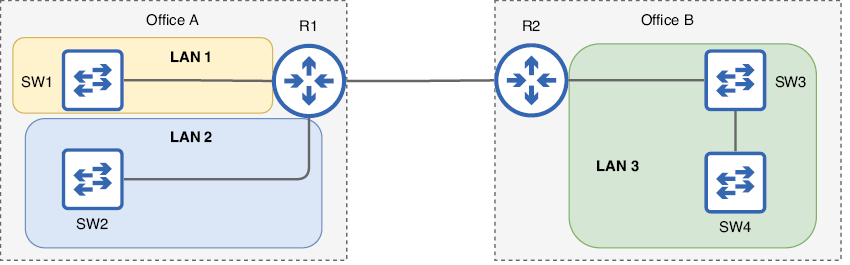
Compare two offices: directly connected switches form one LAN, while switches separated by a router form separate LANs. section 6.1

