liveBook · Manning

Coupling

As explained in Microservices Patterns, Second Edition

Coupling is a dependency between software elements in which changes, failures, or shared resources in one element can affect another.

Coupling is a relationship in which one software element can influence another. Loose coupling limits that influence; tight coupling makes it significant. section 4.1

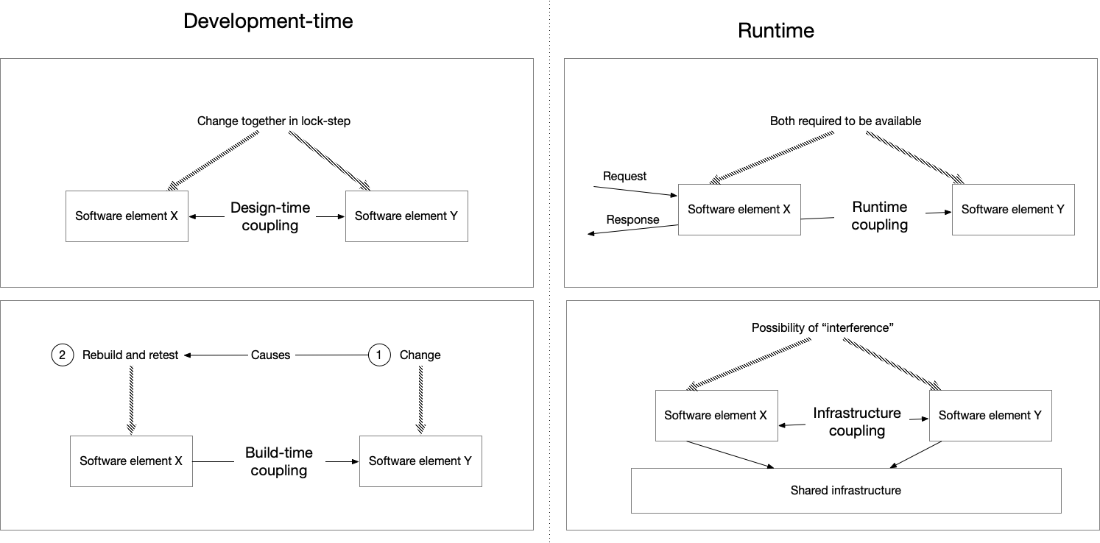
Four forms of coupling affect development or runtime behavior:

  • Design-time: a change to one element may require changing another. section 4.1.1
  • Build-time: changing one element requires another to be recompiled and retested. section 4.1.1
  • Runtime: one element’s failure causes another to fail. section 4.1.1
  • Infrastructure: elements share resources, such as a database, and one element’s behavior affects the other. section 4.1.1

Minimize coupling to support team autonomy, faster deployment, availability, and lower latency. Some coupling is inevitable, and eliminating it can have significant drawbacks. section 4.6

Figure 4.1 There are four different types of coupling: design-time, build-time, runtime, and infrastructure
different kinds of coupling

Use the figure to compare the four forms of coupling. section 4.1.1

How Microservices Patterns, Second Edition covers it

How deep it goes
Defines coupling and distinguishes four forms, linking them to development-time or runtime effects.
Examples
Uses cross-team change coordination and a shared database to illustrate coupling concerns.
What it assumes
Assumes familiarity with software architecture fundamentals while defining coupling from an abstract starting point.
What you can do after
Understand four coupling forms and relate them to development or runtime effects.
How it connects
Connects coupling to availability, ease of change, team autonomy, deployment speed, and latency.

Also explained in

Compare how 22 books explain coupling →

Related concepts

This explainer was generated by Manning's knowledge graph from the text of Microservices Patterns, Second Edition. The section links point to the parts of the book it draws on.




















