A low-code platform lets you build software by assembling visual components, configuring them, and connecting data flows instead of writing every instruction by hand. It raises the level of abstraction so attention shifts from syntax and framework details to application design. section 2.1
For GenAI applications, the platform supplies prebuilt components around a language model. You select, configure, and connect pieces such as input, model, prompts, tools, and output, making the application flow visible and easy to revise. section 1.1 section 2.1
Figure 2.3 Piecing bricks together to get a GenAI app
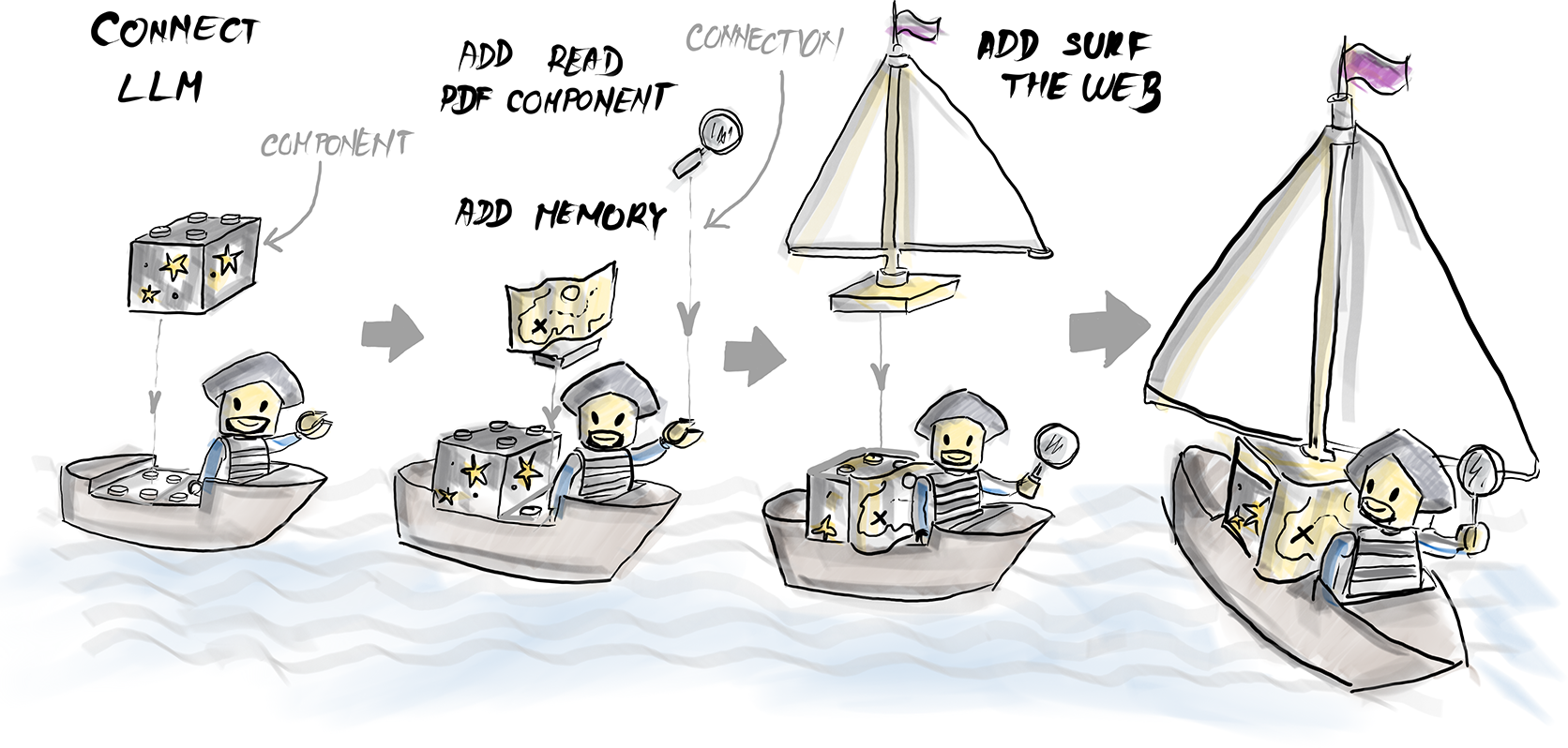
A visual flow resembles assembling Lego bricks: each component performs part of the application and connections show how data moves between them. section 2.2
A low-code platform is useful because it:
- Makes experimentation fast: visual flows support quick experimentation, failure, adjustment, and iteration. section 1.1
- Supports beginners while helping Python developers prototype architectures before expanding them into larger applications. section 1.1
- Does not eliminate code: a visual flow can map to Python concepts and can later be reproduced for greater customization and production control. section 2.4 section 8.6
- Requires practical tool judgment: a public sandbox is convenient but does not guarantee privacy or permanent data storage. section 2.2
A visual chatbot flow
A simple Langflow application connects Chat Input to an OpenAI model and Chat Output, with a system message instructing the assistant to answer in Pirate English. The same flow can be expressed in Python with LangChain. section 2.4
