A low-dimensional vector representation compresses a graph, node, or edge into relatively few numerical dimensions while retaining essential structural and relational information. This makes complex graph data easier to handle, visualize, and use with machine-learning models. section 2.4.1
Use a low-dimensional representation to move from graph structure to practical analysis:
- Represent a node, edge, or entire graph as a compact vector. section 2.4.1
- Interpret similarity through graph connectivity, hop counts, paths, or random-walk probabilities rather than only geometric distance. section 2.4.1
- Use the resulting vectors for two- or three-dimensional visualization, node classification, link prediction, or graph classification. section 2.4.1 section 1.2.3
Figure 2.11 Comparison of similarity concepts: using distance on a plane (left) and using steps along a graph (right)
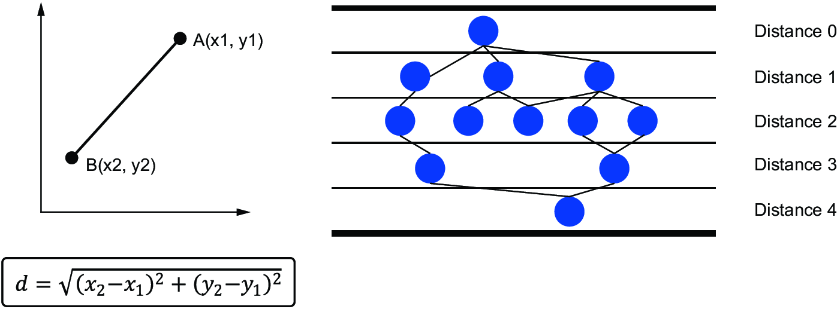
Compare ordinary spatial distance with graph-based similarity measured by steps along connections. section 2.4.1
