Low-rank adaptation (LoRA) is a parameter-efficient fine-tuning method that adapts a language model by training low-rank updates instead of all model weights. section 7.8
Use LoRA to make instruction fine-tuning more efficient, then compare the modified run with the original:
- Modify an existing instruction-fine-tuning implementation to use LoRA. section 7.8
- Compare training runtime before and after applying the method. section 7.8
- Compare model performance using the evaluation procedure and scored responses. section 7.8
Parameter-efficient fine-tuning exercise
Apply LoRA to the instruction-fine-tuning code, run the resulting training workflow, and compare its runtime and model performance with the original full fine-tuning run. section 7.8
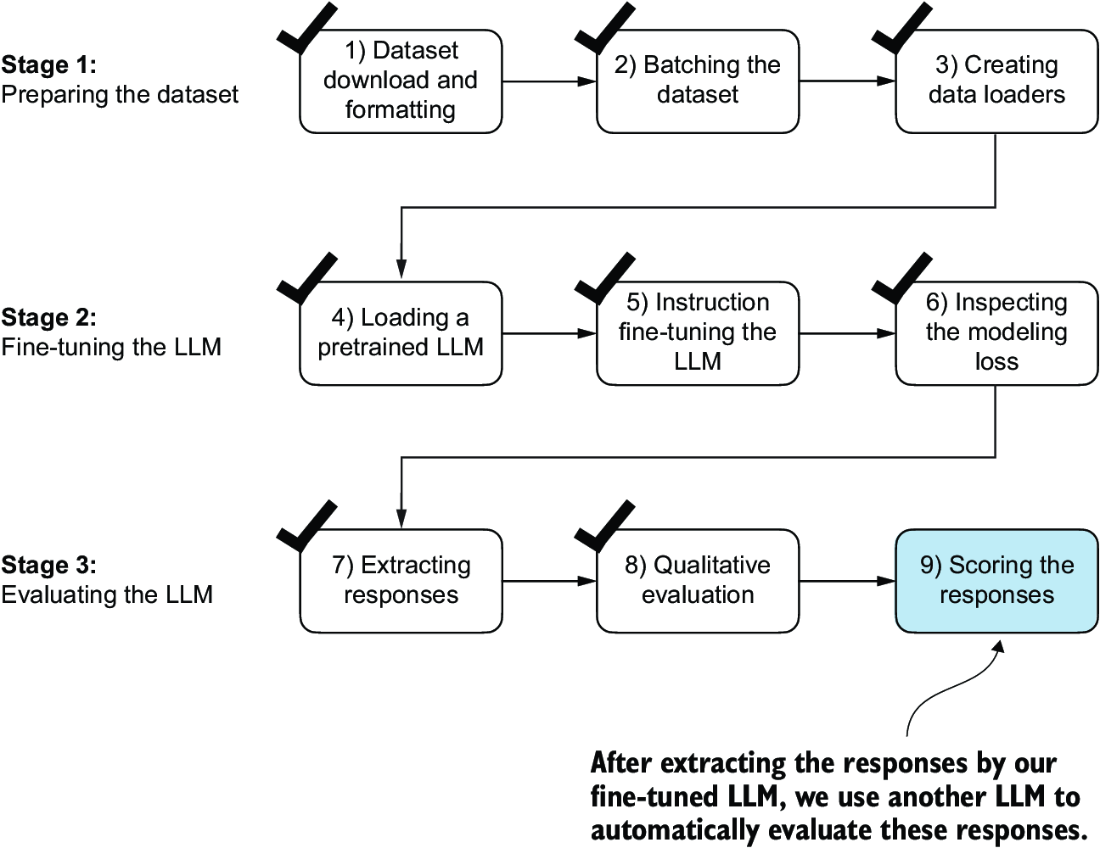
Figure 7.19 The three-stage process for instruction fine-tuning the LLM. In this last step of the instruction-fine-tuning pipeline, we implement a method to quantify the performance of the fine-tuned model by scoring the responses it generated for the test.
Use the instruction-fine-tuning evaluation pipeline to score generated responses and quantify performance differences between runs. section 7.8