Low-rank adaptation (LoRA) specializes a pretrained large language model without updating all its weights. It is a parameter-efficient fine-tuning method: instead of retraining the full model, it trains a much smaller set of added parameters. This makes adapting large models more practical when computing resources are limited. section 9.1.1 section 9.6
LoRA adds small, low-rank matrices to model layers, including attention and feed-forward layers. During training, the original pretrained weights remain frozen while the added matrices are updated. In the layer diagram, W is the frozen weight, X is the input, and A and B are the trainable adaptation parameters. section 9.6.1
Figure 9.14 LoRA reparameterization—only A and B are trained [9]
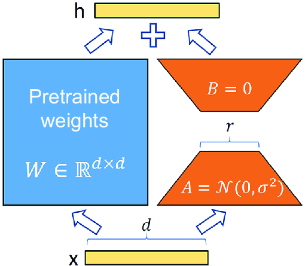
Use the diagram to distinguish the frozen pretrained weight W from the trainable adaptation parameters A and B. section 9.6.1
For a task-specific adaptation, the main practical trade-offs are:
- Train and store fewer parameters than with full-model fine-tuning; task-specific parameters can be loaded alongside the pretrained model. section 9.6.1
- Keeping pretrained weights fixed helps retain general capabilities, but it does not remove the need to evaluate the adapted model. section 9.6 section 9.8
- Plan for task-specific data, repeated evaluation, and ethical considerations before production deployment. section 9.8








