An LRU cache stores recently accessed values and, at capacity, evicts the entry unused for the longest time. It suits systems that avoid recomputing results by reusing cached entries. section 7.0 section 7.4
The design combines a hash table with a doubly linked list. The table finds a key and points to its list node; the list keeps most-recently-used entries at the front and the least-recently-used entry at the tail. section 7.4.1 section 7.4.2
Core operations follow the same ordering invariant:
- On a cache hit, retrieve the node through the hash table and return its value. section 7.4.2
- When setting an existing key, update its node and move it to the list front. section 7.4.2
- When setting a new key at capacity, remove the tail node and its hash-table entry, then add the new node at the front. section 7.4 section 7.4.2
Adding and evicting an entry
Suppose “Acme” is absent from a full cache. Add its node at the list front, insert a hash-table pointer to that node, and remove the node formerly at the tail. The list now records Acme as most recently used. section 7.4.2
Figure 7.5 Structure of an LRU cache. You can see the tree data elements that are stored for the cache and need to be updated after every operation: (1) The hash table. (2) The head of a doubly-linked list. (3) A pointer to the last element in the list. Notice how each element in the hash table points to a node in the list where all the data is stored. To get from a list entry to the corresponding hash entry, we have to hash the name of the company stored in the node, which is the key for the table. For the sake of simplicity, collision resolution is not considered in this and the following figures.
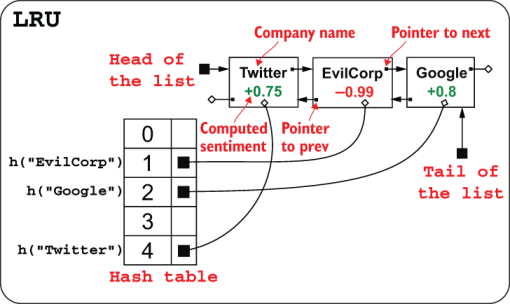
Inspect the structure linking the hash table, list head, tail pointer, and shared list nodes. section 7.4.2

