Machine Learning System Design is a production-focused methodology that organizes machine learning work around problem definition, data, modeling, and serving. It contrasts research implementations with operational requirements, including performance and compute constraints. section 1.3
Structure the work into four connected phases:
- Project setup: clarify goals, user experience, performance constraints, evaluation, personalization, people, compute, and infrastructure. section 1.3
- Data pipeline: address privacy, bias, storage, preprocessing, and data availability. section 1.3
- Modeling: handle model selection, training, debugging, hyperparameter tuning, and scaling. section 1.3
- Serving: evaluate the model and examine assumptions involved in running it in the field. section 1.3
Figure 1.4 ML project flow as described in Huyen and Hopper (2020). Figure redrawn and adapted by the author. Arrows represent dependency relations rather than workflow.
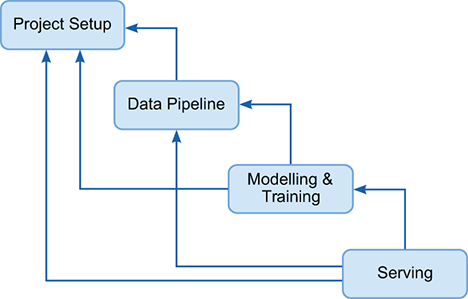
Use the project-flow diagram to navigate dependencies among setup, data, modeling, and serving; its arrows represent dependencies rather than workflow. section 1.3

