Majority voting selects an option only when it receives more than half of the votes. It offers a clear way to move a group from competing design alternatives to a provisional decision, but it is not a license to disregard the people who voted differently. A majority can settle which direction to pursue while still exposing concerns that must be addressed for the decision to last. section 9.2.3
Use the vote after the alternatives have been made clear and the group has had space to express its views. Give every participant one vote, state that more than half is required, and vote only when an option seems likely to gain a majority or when taking a position may reveal perspectives that have remained unspoken. section 9.2.3
A majority vote can be facilitated as a decision-and-listening loop:
- Present the alternatives clearly, and require each person to choose only one option. section 9.2.3
- Check whether an option has more than half the votes. If not, return to discussion, surface further perspectives, and repeat the earlier exploration up to three times. section 9.2.3
- Treat a majority as a signal to investigate the minority, not as the end of the process. section 9.2.3
- Ask dissenters, “What would it take for you to go along?” Then incorporate relevant needs into the chosen direction and vote on them until agreement is unanimous. section 9.3.1 section 9.2.3
- If unanimity remains out of reach, resume searching for unspoken alternative viewpoints rather than forcing closure. section 9.2.3
Splitting Pricing and Payments
A team considered either keeping its current Payments design or splitting it into Pricing and Payments. Three people voted to keep the design; fifteen supported the split, so the team adopted the alteration. The follow-up question uncovered that a dissenter was not opposed to the improvement itself: he wanted the Back-Office Separated alternative examined with equal care. The resulting concern became a requirement for fairer exploration, rather than hidden resistance to the vote. section 9.3.1
Figure 9.6 Caledon’s suggestion to further split up the Payments bounded context into two and renaming the Payments domain to Pricing and Payments
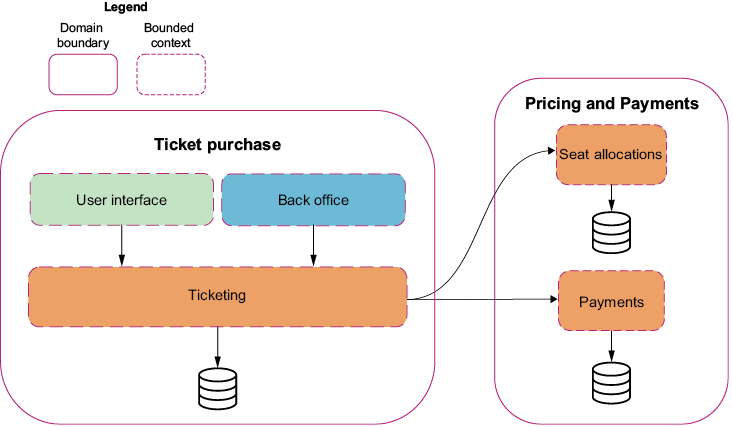
Compare the proposed Pricing and Payments split with the existing design to make the voted-on alternative concrete before discussing its trade-offs and dissenting concerns. section 9.3.1
Voting dynamics can conceal problems. Collaborative modeling may favor extroverted, quick decision-makers while more analytical participants need longer to form or voice their views. A person may also oppose a choice because of fairness, incomplete exploration, or another concern unrelated to the option’s technical merits. Make room for those reasons before they harden into conflict or resistance. section 9.3.1 section 9.2.3







