Majority voting predicts a classification label by selecting the class receiving the most votes from multiple models. It pools diverse predictions into one decision, helping reduce variance and produce more reliable results. section 5.1.1 section 5.1.2
Use majority voting when combining models for classification, while weighing the practical trade-offs:
- Pasting trains models on subsamples drawn without replacement, then combines their classification predictions by majority voting. section 5.1.1
- Random forests combine decision trees built with bootstrapping and feature sampling; the most frequent class becomes the prediction. section 5.1.2
- Ensembling can improve reliability and accuracy, but multiple models require more computation and subsampling can exclude important data patterns. section 5.1.1 section 5.1.2
Random-forest classification
For the Airbnb NYC classification problem, a RandomForestClassifier combines 300 trees after categorical one-hot encoding and numeric preprocessing. Each tree votes, and the most common class forms the final prediction. section 5.1.2
Figure 5.4 How random forests arrives at its results by combining the different data partitioning due to its decision trees thanks to majority voting
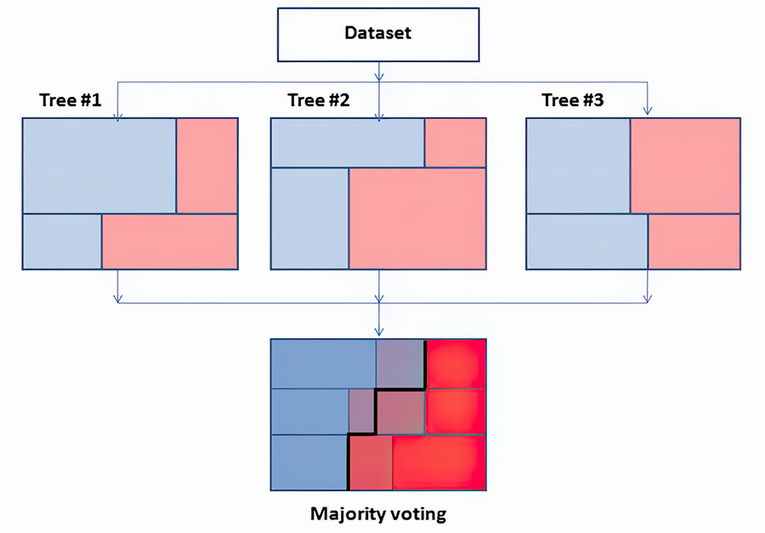
Shows how different decision-tree partitions combine into a shared classification boundary through majority voting. section 5.1.2







