Malicious code, or malware, is harmful software that infects a target computer and performs malicious actions. It is treated as a technical threat because it can compromise the confidentiality, integrity, or availability of systems or data. section 11.6 section 11.2.1
Recognize malware in these security relationships:
- A botnet is a group of devices infected with malware and used to attack a target from multiple devices. section 11.2.1 section 11.6
- A distributed denial-of-service attack uses such a botnet to disrupt a target’s availability. section 11.2.1 section 11.6
- Distinguish malware from an exploit, threat, vulnerability, and mitigation: malware is the harmful software, while the others describe weaknesses, possibilities, risks, or protections. section 11.6
Malware-enabled DDoS
An attacker uses a botnet of malware-infected devices to flood a target with TCP SYN messages. The resulting half-open connections fill the target’s TCP connection table and prevent legitimate connections. section 11.2.1 section 11.6
Figure 11.2 A TCP SYN flood attack—an example of a DoS attack. (1) The target is flooded with SYN messages and (2) replies with SYN-ACK messages. (3) The half-open TCP connections prevent the target from accepting legitimate TCP connections.
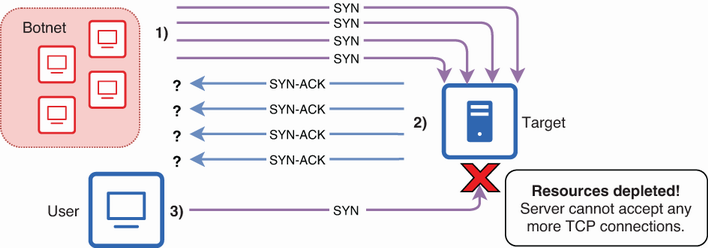
Trace how a SYN flood consumes connection capacity; the distributed form can be generated by a malware-based botnet. section 11.2.1


