Why can a classifier recognize a handwritten digit it has never seen? It could memorize its training images—even a model trained on randomly shuffled labels can fit those labels. Generalization depends instead on a useful property of real data: valid inputs are not scattered randomly among every possible input. section 5.1.2
Handwritten digits
An unprocessed MNIST image is a 28 × 28 array whose entries can each take 256 values. Almost none of the possible arrays look like digits. The recognizable ones occupy a small, structured part of that vast space. Change a digit slightly and it usually remains recognizable; follow a smooth sequence of small changes and one digit can gradually morph into another. section 5.1.2
The manifold hypothesis describes this structure as data lying on or near a lower-dimensional manifold within the full input space. Nearby valid examples can make interpolation useful for learning. But interpolation must respect the data’s shape: simply averaging two digit images usually does not produce a valid digit. section 5.1.2
Figure 5.8 Difference between linear interpolation and interpolation on the latent manifold. Every point on the latent manifold of digits is a valid digit, but the average of two digits usually isn’t.
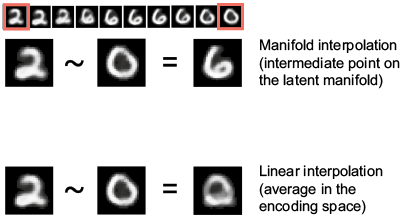
Compare a straight average of two digits with a path along the latent manifold; the distinction shows why not every point between two image arrays is a useful example. section 5.1.2
As a rule of thumb, deep learning is a strong choice for perception tasks when there is plenty of data and this hypothesis applies. Do not assume the same approach will solve every abstraction problem: discrete reasoning and perception call for different strengths. section 19.4.3

