Generalization
Generalization is the extension of learned patterns, abstractions, or conclusions from observed cases to new cases beyond those from which they were derived.

Deep Learning with Python, Third Edition
The ability of a model or agent to perform well on novel situations different from those seen during training or prior exposure.
- How it is used
- Uses generalization as the goal guiding model evaluation, fitting, and regularization.
- How deep it goes
- Explains interpolation and memorization, then gives evaluation protocols and a procedural fitting and regularization workflow.
- Examples
- Uses shuffled-label MNIST, capacity comparisons, movie-review classification, and augmented images to illustrate generalization.
- What you can do after
- Diagnose/debug generalization by comparing training and validation results, checking baselines, and tuning capacity or regularization.
Read how Deep Learning with Python, Third Edition explains generalization →

Deep Learning with R, Third Edition
Generalization is a model's ability to perform accurately on previously unseen inputs from the same underlying domain as its training data.
- How it is used
- Frames unseen-data performance as the goal guiding model development and evaluation.
- How deep it goes
- Explains underfitting, overfitting and interpolation, then gives a workflow for evaluation and improvement.
- Examples
- Uses shuffled MNIST labels to contrast training fit with validation performance and IMDb reviews to explore regularization.
- What you can do after
- Diagnose/debug generalization by comparing training and validation metrics, checking baselines, and testing data or model changes.
Read how Deep Learning with R, Third Edition explains generalization →

Timeless Algorithms, The Foundational Ideas
Generalization is the ability of a learned model to perform effectively on observations not used during training.
- How it is used
- Frames performance on unseen observations as a design objective across classifiers and neural networks.
- How deep it goes
- Explains capacity control and ensemble strength and correlation, while distinguishing empirical estimates from guarantees of future performance.
- Examples
- Uses a temperature classification threshold and held-out language-model prediction to illustrate generalization.
- What you can do after
- Evaluate and understand generalization strategies and evidence without treating training fit or held-out performance as a universal guarantee.
Read how Timeless Algorithms, The Foundational Ideas explains generalization →

Build AI Drug Discovery Pipelines
Generalization is a model's ability to maintain predictive performance on previously unseen data drawn from the relevant distribution.
- How it is used
- Uses unseen-data performance to assess whether drug-discovery models can predict for new compounds.
- How deep it goes
- Explains evaluation with held-out data, cross-validation, validation curves, and training-loss monitoring, including contamination and molecular-split pitfalls.
- Examples
- Illustrates evaluation with a molecular classifier, solubility-model validation curves, and neural-network training and validation losses.
- What you can do after
- Diagnose overfitting and evaluate generalization using cross-validation, held-out loss, and validation curves.
Read how Build AI Drug Discovery Pipelines explains generalization →

Natural Language Processing in Action, Second Edition
Generalization is a model's ability to produce useful predictions for previously unseen inputs, including inputs outside its training examples.
- How it is used
- Uses learned patterns to predict unfamiliar names and assess whether language models extend beyond memorized examples.
- How deep it goes
- Explains out-of-distribution behavior, demonstrates character n-gram features, and tests LLM brittleness, but stops short of formal generalization theory.
- Examples
- Uses original names such as Carlana and Cason, character n-gram vectors, and GPT-2’s cow-leg question.
- What you can do after
- Apply it via character n-gram vectorization and evaluate LLM outputs for reliable transfer beyond observed language patterns.
Read how Natural Language Processing in Action, Second Edition explains generalization →

Sutskever's List
Generalization is a model's ability to maintain predictive performance on inputs beyond those used for training.
- How it is used
- Tests whether apparent success reflects transferable patterns rather than quirks of training data or a benchmark.
- How deep it goes
- Explains overfitting through augmentation and a model-complexity trade-off, without a formal derivation or generalization metric.
- Examples
- Uses a water-as-car detection error, AlexNet’s image transformations, and contrasting ARC-AGI results.
- What you can do after
- Evaluate/understand it by questioning benchmark gains, checking performance on novel tasks, and recognizing why augmentation can reduce overfitting.

Deep Learning with PyTorch, Second Edition
The ability of a trained model to perform well on data not seen during training by capturing underlying patterns rather than memorizing specifics.
- How it is used
- Uses generalization to judge whether a model learns patterns that transfer beyond its training samples.
- How deep it goes
- Explains loss-curve diagnosis and compares architectural and augmentation choices, without a formal theory of generalization.
- Examples
- Illustrates generalization with thermometer fitting, face-to-age prediction, and bird-versus-airplane image classification.
- What you can do after
- Diagnose overfitting with training and validation losses, and evaluate accuracy on held-out samples.
Read how Deep Learning with PyTorch, Second Edition explains generalization →
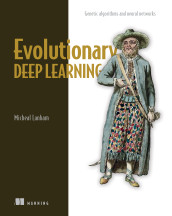
Evolutionary Deep Learning: Genetic algorithms and neural networks
Generalization is a model's ability to perform well across environments or data conditions beyond those directly optimized during development.
- How it is used
- Distinguishes memorization from performance on held-out data or additional environments.
- How deep it goes
- Works through CNN regularization and multi-environment genetic-programming experiments, while noting imperfect results and a failed equation-evolution attempt.
- Examples
- Uses a high-capacity CNN, a pooled normalized CNN, equation evolution across two environments, and an artificial ant on three trails.
- What you can do after
- Apply it via Keras and DEAP by comparing validation behavior and evolving routines across multiple environments.

Generative AI in Action
Generalization is a model's ability to perform effectively on examples that were not present in its training data.
- How it is used
- Uses validation behavior to determine whether a fine-tuned model transfers performance beyond its training examples.
- How deep it goes
- Explains training-validation loss patterns, overfitting, underfitting, batch noise, and stability without deriving model internals.
- Examples
- Uses training-loss curves for GPT-3.5 Turbo fine-tuning and contrasts improving, overfit, and underfit loss patterns.
- What you can do after
- Diagnose fine-tuning quality by comparing training and validation loss and recognizing overfitting or underfitting.
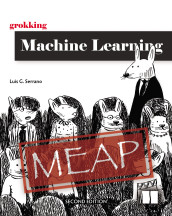
Grokking Machine Learning, Second Edition
Generalization is a model's ability to make accurate predictions on data different from the examples used for training.
- How it is used
- Uses unseen-data performance to choose models that capture patterns instead of memorizing training examples.
- How deep it goes
- Explains train-test evaluation, memorization, and complexity through polynomial examples, stopping short of implementation details.
- Examples
- Uses spam-classification rules, an exam analogy, and degree-1, degree-2, and degree-10 polynomial models.
- What you can do after
- Evaluate models with a testing set and select the option that generalizes with low testing error.
Read how Grokking Machine Learning, Second Edition explains generalization →

The AI Pocket Book
The ability of a model to perform well on new inputs not seen during training.
- How it is used
- Frames machine learning success as performance on inputs beyond the training examples.
- How deep it goes
- Defines generalization through unseen inputs and contrasts it with overfitting and underfitting, without covering measurement methods.
- Examples
- Uses new sentences, new images, and image categories such as dogs and planes.
- What you can do after
- Evaluate whether a model learned a general process by checking performance on data absent from training.

Machine Learning Algorithms in Depth
The ability of a learned model to perform accurately on previously unseen examples.
- How it is used
- Frames generalization as the central goal of machine learning and the reason learned models should work beyond their training data.
- How deep it goes
- Defines the training-versus-test objective but does not derive methods for improving generalization or analyze model internals.
- Examples
- Uses training examples and new test examples as the concrete comparison for judging accuracy and loss.
- What you can do after
- Evaluate/understand whether a model performs accurately beyond its labeled training data by examining unseen test examples.
Read how Machine Learning Algorithms in Depth explains generalization →
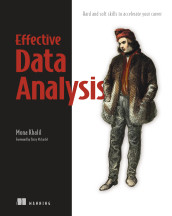
Effective Data Analysis
The extent to which findings from a study apply to populations, settings, or conditions beyond those directly examined.
- How it is used
- Guides analytics deliverables by limiting findings to conclusions supported by the research design, methodology, and observed population.
- How deep it goes
- Defines interpretation scope and links it to precise language, but stops short of presenting formal generalization procedures.
- Examples
- Uses Help Center visits, chat volume, search optimization, and scope-of-interpretation presentation slides as examples.
- What you can do after
- Apply it via precise language that clarifies supported conclusions, limits overreach, and prompts stronger stakeholder questions.
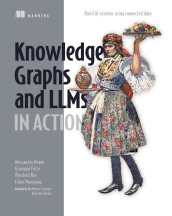
Knowledge Graphs and LLMs in Action
Generalization is the process of deriving a broader model or conclusion that applies beyond the observed examples.
- How it is used
- Uses generalization to distinguish learning systems from programs that merely memorize labeled examples.
- How deep it goes
- Defines generalization through spam filtering and contrasts inductive and deductive reasoning, without detailing model-training internals.
- Examples
- Uses spam filtering, unseen emails, labeled messages, coins, and bald grandfathers to illustrate generalization and its risks.
- What you can do after
- Evaluate/understand whether a system learns patterns for unseen cases or only retrieves previously stored examples.
Read how Knowledge Graphs and LLMs in Action explains generalization →
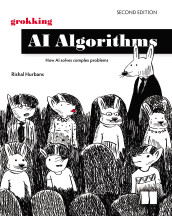
Grokking AI Algorithms, Second Edition
Generalization is a model's ability to perform effectively on new data drawn from the same underlying task or distribution.
- How it is used
- Evaluates whether a trained model can handle unseen data rather than merely reproduce its training examples.
- How deep it goes
- Explains memorization, validation loss, and early stopping procedurally, without developing a formal theory of generalization.
- Examples
- Uses an exam analogy, training-versus-validation loss, early stopping, and language models learning rare words and writing styles.
- What you can do after
- Diagnose/debug with it by comparing training and validation loss and stopping training when validation performance deteriorates.
Read how Grokking AI Algorithms, Second Edition explains generalization →
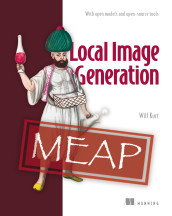
Local Image Generation
The ability of a learned model or representation to apply beyond the specific examples used for learning.
- How it is used
- Explains why Stable Diffusion compresses images while preserving patterns useful for generating unfamiliar images.
- How deep it goes
- Explains the compression rationale and connects it to VAE encoding, decoding, and latent space.
- Examples
- Uses an elementary-school house drawing and imperfect image reconstruction to illustrate useful abstraction.
- What you can do after
- Evaluate/understand why task-specific lossy compression can improve generation beyond memorized examples.
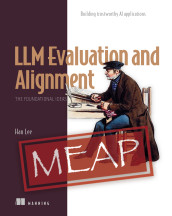
LLM Evaluation and Alignment, The Foundational Ideas
Generalization is the ability of a model to apply learned behavior or principles to novel inputs beyond its training examples.
- How it is used
- Evaluates whether alignment principles transfer from demonstrations to unfamiliar prompts.
- How deep it goes
- Explains shallow failure, its cause, and a midtraining remedy, but does not detail the reported evaluation metrics.
- Examples
- Uses spec articles, dialogues, examples, FAQs, critique-revised demonstrations, and held-out prompts.
- What you can do after
- Evaluate whether a model applies a specification beyond prompts resembling its demonstrations.
Read how LLM Evaluation and Alignment, The Foundational Ideas explains generalization →

Machines that Think
Generalization is the ability of a learned system to apply patterns or representations beyond the data on which it learned them.
- How it is used
- Frames generalization as both a learning objective and an observable capability in debates about machine intelligence.
- How deep it goes
- Defines generalization through its contrast with memorization and connects it to abstraction, without detailing how to produce it.
- Examples
- Contrasts a network that reproduces training examples with one that responds to new data.
- What you can do after
- Evaluate it by distinguishing pattern extraction from memorization and treating generalization as evidence of abstraction, not awareness.
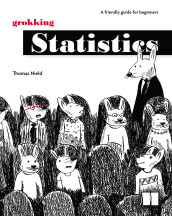
Grokking Statistics
Generalization is the ability of a fitted model to perform appropriately on new data beyond the observations used to fit it.
- How it is used
- Checks whether fitted classification models make reliable predictions beyond their training observations.
- How deep it goes
- Explains memorization, train/test splits, and cross-validation, while deferring advanced logistic-regression metrics and hypothesis tests.
- Examples
- Uses a fitted logistic regression model, memorized training data, withheld validation data, and cross-validation.
- What you can do after
- Evaluate whether a fitted model’s predictions extend to unseen data using train/test splits or cross-validation.
Also covered in
- 100 SQL Server Mistakes and How to Avoid Them
- Ensemble Methods for Machine Learning
- Graph Neural Networks in Action
- Reinforcement Learning from Human Feedback
- Build a DeepSeek Model (From Scratch)In early access (MEAP)
- Machine Learning System Design
- Delivering Machine Learning Projects: From design to deployment
- Simple Object-Oriented Design: Create clean, maintainable applications
- Understanding AIIn early access (MEAP)
- LLM Customization and Fine-TuningIn early access (MEAP)
- Machine Learning for Tabular Data: XGBoost, Deep Learning, and AI
- Privacy-Preserving Machine Learning
What to know first
- language modelA language model is a computational model that represents patterns in linguistic sequences to assign probabilities, predict, generate, or evaluate language.
- parameterA parameter is a value or named input that specifies or influences the behavior, computation, or output of a function, model, or system.
- accuracyAccuracy is the degree to which a result agrees with a specified truth, reference, or criterion, commonly measured as the proportion of evaluated predictions that are correct.
- objective functionAn objective function is a mathematical function that assigns values to candidate solutions or parameter settings, which an optimization procedure seeks to minimize or maximize.
Related concepts
- validation lossmeasured by · The value of a loss function computed on held-out validation data to assess a model’s predictions.
- Abstraction & Reasoning Corpus for Artificial General Intelligencemeasured by · The Abstraction and Reasoning Corpus for Artificial General Intelligence is a benchmark of visual reasoning tasks designed to assess abstract rule induction and generalization from examples.
- memorizationcontrasts with · Memorization is the retention of specific information or examples in a form that enables their later recall or reproduction.
- optimizationcontrasts with · Optimization is the systematic selection or modification of values, configurations, or implementations to improve a defined objective, often subject to constraints.
- metricmeasured by · A metric is a quantitative measure that assigns values to a property or outcome so it can be assessed, compared, or monitored.
Questions about generalization
What is generalization?
Generalization is the extension of learned patterns, abstractions, or conclusions from observed cases to new cases beyond those from which they were derived.
Which Manning books explain generalization?
Deep Learning with Python, Third Edition, Deep Learning with R, Third Edition, Timeless Algorithms, The Foundational Ideas, Build AI Drug Discovery Pipelines, Natural Language Processing in Action, Second Edition, Sutskever's List, Deep Learning with PyTorch, Second Edition, Evolutionary Deep Learning: Genetic algorithms and neural networks and 11 more.
What should I know before learning generalization?
Manning books that teach generalization usually introduce language model, parameter, accuracy and objective function first.
What is the difference between generalization and memorization?
Generalization is the extension of learned patterns, abstractions, or conclusions from observed cases to new cases beyond those from which they were derived. Memorization is the retention of specific information or examples in a form that enables their later recall or reproduction.
What is generalization also called?
Generalization is also called generalize, generalizing, generalizability or generalized.
These guides are generated from the text of Manning books by Manning's knowledge graph and link to the sections they draw on. The full books are available on liveBook and at manning.com.