A detector can score well on a benchmark and still mistake rippled water for a car. Generalization is the ability to perform beyond the examples and quirks a model was trained on. Late-2000s object detectors built around hand-engineered HOG features illustrate the problem: hard negative mining repeatedly retrained a detector on its false positives, improving its decision boundary while potentially sculpting it around a particular dataset. section 2.1
Figure 2.1 This figure shows a goose swimming (top), where an object detector mistakenly labels a small patch of rippled water as a car. Below the image are three visualizations that clarify the source of this error: a close-up of the water patch (left), the corresponding HOG features (middle), and a specialized visualization (right) showing that the rippled water’s features resemble those associated with cars in HOG feature space. Used with permission granted by the lead author (Carl Vondrick).
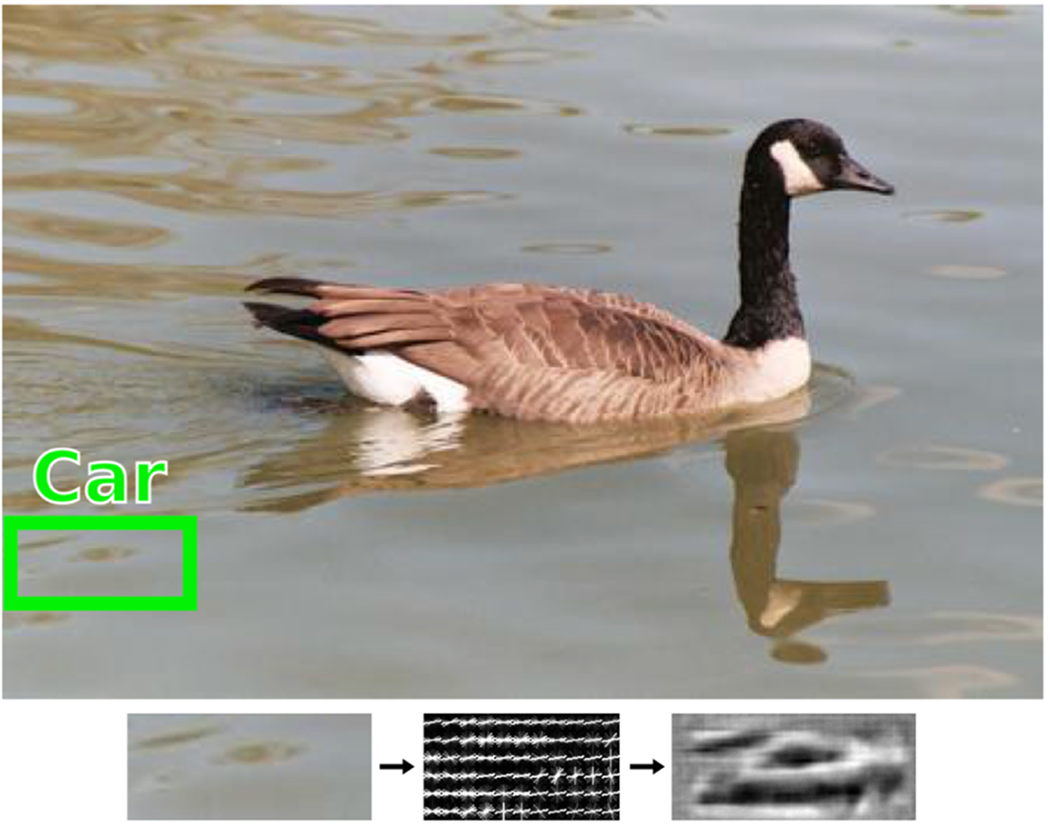
Compare the water patch with its HOG visualization to see why a strong feature-based detector could produce a conspicuous false positive. section 2.1
AlexNet attacked a related risk during training. Random crops and horizontal reflections varied where objects appeared; PCA-based color jitter varied their appearance under changing illumination. These transformations expanded ImageNet’s effective diversity. Together with dropout, they helped a 60-million-parameter network fit its training data without losing performance on unseen ImageNet test images. section 2.5.3
A held-out test is not the end of the question. Strong results on ARC-AGI-1 appeared to signal progress toward general abstraction, yet the same family of models scored below 3% on ARC-AGI-2. The contrast raised the possibility that solutions had become specialized to the first benchmark’s conditions. Introducing genuinely novel tasks tests whether a capability travels beyond the test that made it look convincing. section 7.6
One way to frame the trade-off is compression: a useful model captures regularities without storing noise as though it were a rule. Too much fit can resemble a lookup table; too simple a model misses structure. Neither training accuracy nor success on one benchmark, by itself, settles which side of that trade-off a model has reached. section 8.2.1 section 7.6












