Generalization is a model’s ability to perform effectively on examples that were absent from training. In fine-tuning, it matters because a model can learn the training set without learning patterns that transfer to new inputs. section 9.3.4 section 9.1.2
Use training and validation loss to assess whether fine-tuning is learning transferable patterns:
- A good fit shows both losses decreasing toward stability, with only a small gap between them. section 9.3.4
- Overfitting is likely when training loss decreases while validation loss increases; the model is fitting training data but generalizing poorly. section 9.3.4
- Underfitting is likely when both losses remain high, indicating that the model has not learned the underlying patterns sufficiently. section 9.3.4
- Judge loss by its scale, training-step count, and stability; batch-level fluctuations are normal when the overall loss improves. section 9.3.4
Reading a fine-tuning run
A fine-tuning run may show steadily declining training loss. If validation loss also declines and stabilizes nearby, the model is likely generalizing well. If validation loss begins rising, investigate overfitting rather than simply adding training steps. Figure 9.3 provides a training-loss view for GPT-3.5 Turbo fine-tuning. section 9.3.4
Figure 9.3 Training loss when fine-tuning GPT-3.5 Turbo
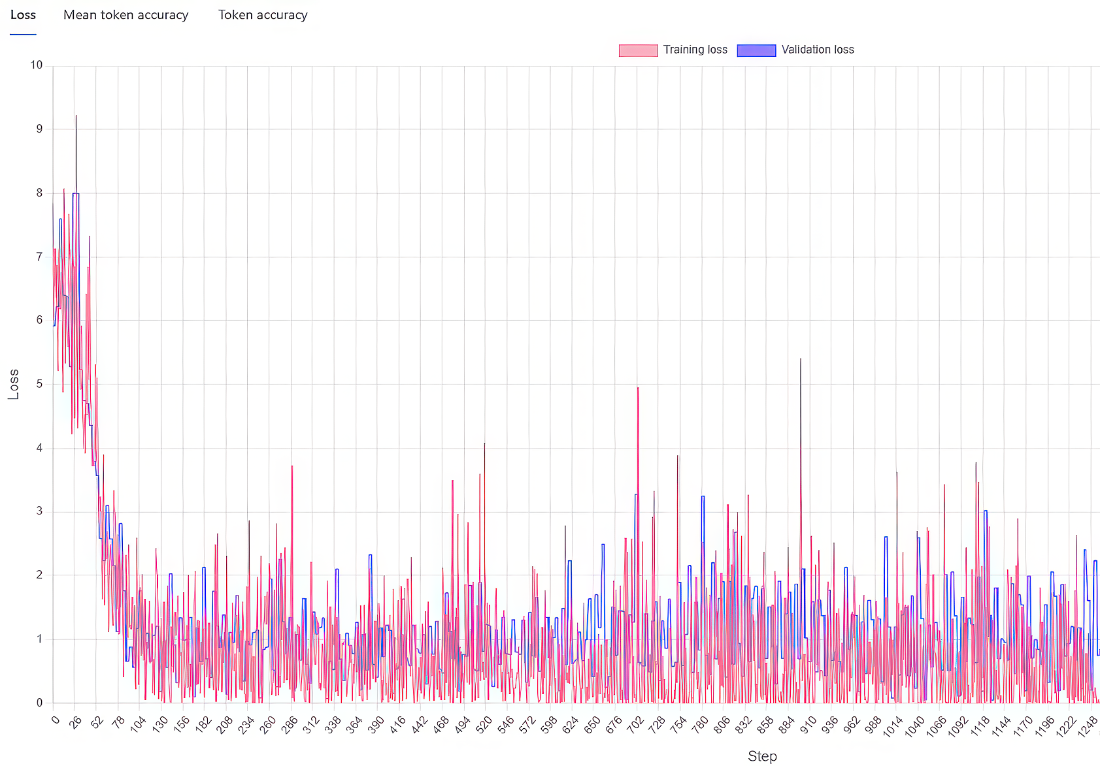
Inspect the training-loss figure to compare progress across training steps and relate loss behavior to generalization. section 9.3.4












