A decision-boundary margin describes how robustly a classifier separates observations into predicted classes. A narrow margin means small sample noise can materially change precision and recall. section 7.4
Compare metric distributions with and without normally distributed noise. Large shifts—such as increased recall paired with decreased precision—signal that the boundary is not robust. section 7.4
Testing boundary robustness
Use Poisson bootstrap samples to estimate metric distributions, then add noise as a hyperparameter. Evaluate bootstrapped lower confidence bounds for recall at a chosen precision or specificity. section 7.4
Distribution of precision and recall with sample size of 200;000; every point is a bootstrapped original dataset, no noise added.
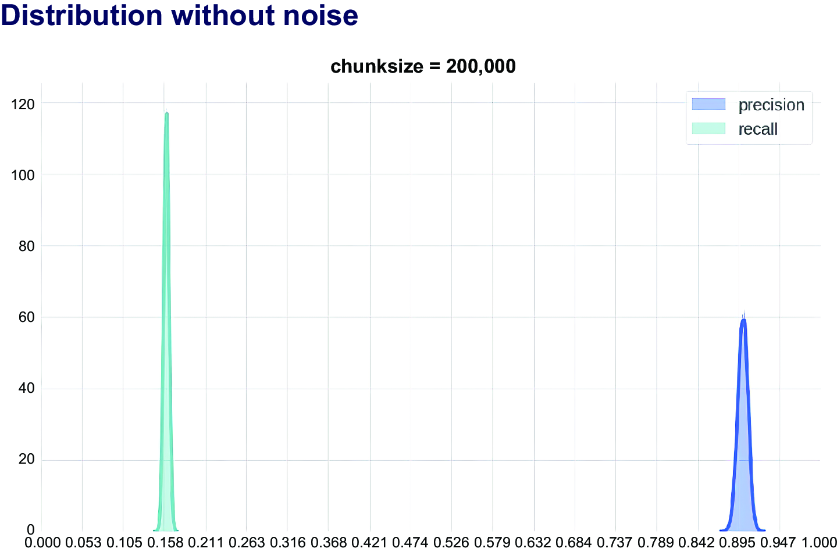
Inspect the no-noise bootstrap distribution before comparing it with the corresponding noise-added distribution. section 7.4

