An AI-powered threat detection system applies artificial intelligence and machine learning to identify cybersecurity threats. It connects detection performance with organizational risk, operational continuity, compliance, and financial value. section 4.3.4 section 10.3.4
A practical deployment combines machine-learning anomaly detection with predictive threat intelligence. It can learn patterns in network traffic or user behavior, identify deviations such as advanced persistent threats, and reduce response time by anticipating vulnerabilities. section 10.3.4
Common analytical components include:
- Machine-learning algorithms such as random forests, support vector machines, and neural networks detect suspicious patterns in network traffic or user behavior. section 10.3.4
- Deep-learning models such as convolutional and recurrent neural networks process large datasets in real time and can expose subtle anomalies such as lateral movement. section 10.3.4
- Natural language processing analyzes logs, emails, and threat reports, while tools such as GPT models or Wazuh support threat-intelligence analysis and anomaly detection. section 10.3.4
SecureShield and HealthSecure
SecureShield struggled with advanced persistent threats and slow response before integrating machine-learning anomaly detection and predictive threat intelligence. In a separate healthcare scenario, a $500,000 investment was associated with four-hour rather than 24-hour incident response, zero successful ransomware attacks, a 100% HIPAA audit pass rate, and $3 million in reported value from breach prevention and operational savings. section 10.3.4 section 4.3.4
Figure 10.2 The left side shows the advanced threat detection metric dashboard for SecureShield before implementing improvements. On the right is the metrics after implementing dynamic risk scoring with anomaly detection and real-time threat intelligence feeds.
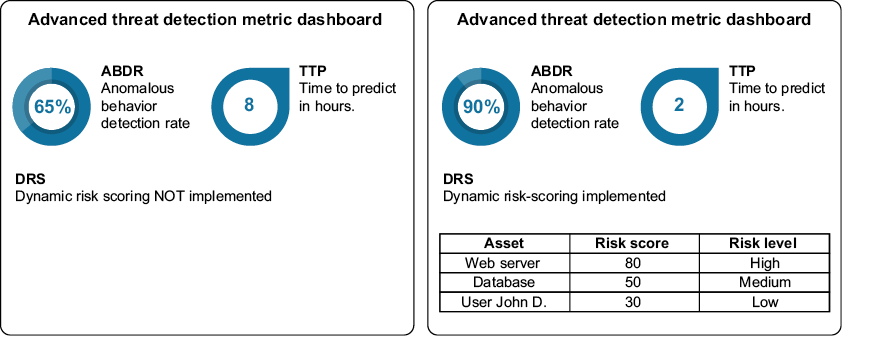
Compare SecureShield's advanced threat-detection metrics before and after dynamic risk scoring, anomaly detection, and real-time threat-intelligence feeds. section 10.3.4
