Medallion architecture organizes data into progressive layers, moving from raw capture to consistent, analytics-ready information and finally to campaign-ready datasets. It gives fragmented marketing data a controlled path from collection to action. section 5.3.1 section 5.5
Use the layers to assign each stage a clear responsibility:
- Bronze captures raw data in full fidelity, preserving incoming interactions and source detail. section 5.3.1 section 5.3.5
- Silver cleanses, transforms, and unifies data so it becomes consistent and analytics-ready. section 5.3.1 section 5.3.5
- Gold prepares trusted datasets for direct campaign activation, audience segments, and advanced analytics. section 5.3.1 section 7.6.3
Abandoned cart recovery
An abandoned-cart interaction enters the bronze layer as raw activity, is cleaned and unified in silver, and reaches gold as a dataset that can power a real-time campaign through a composable CDP. section 5.3.1 section 5.3.5
First-party audience activation
A segment such as high-value customers who have not engaged with email for 30 days can be refined through the layers and synchronized to email or paid-media platforms for tailored follow-up. section 7.6.3
Figure 5.3 Medallion architecture for abandoned cart recovery
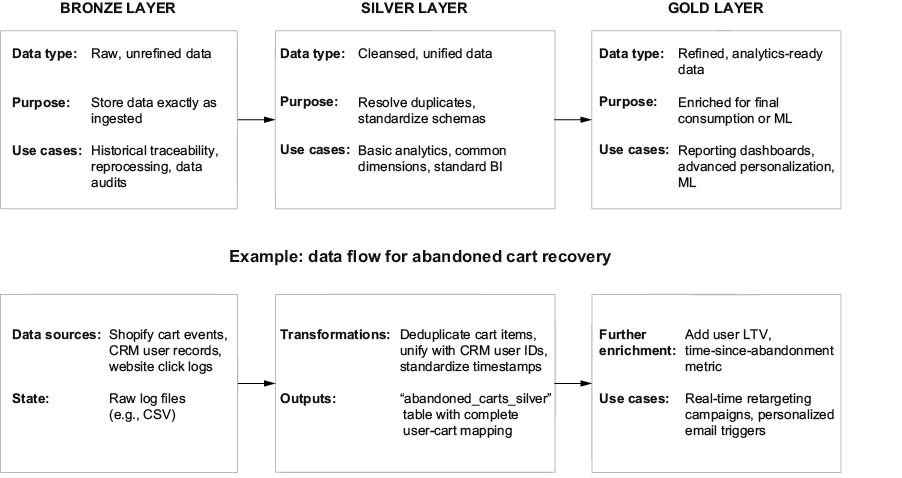
Trace the abandoned-cart journey visually from raw interactions through transformation to real-time campaign activation. section 5.3.1
