Memorization is when a model stores frequent patterns or ready-made solutions instead of learning a rule that generalizes. It can produce familiar answers impressively, then fail on an unusual version of the same problem. section 2.8
When the shortcut breaks
A model may recognize cows only when grass appears beneath them. It can perform well on ordinary training-like images but fail to identify a cow on a beach. Similarly, a language model may memorize a common solution and fail when a familiar problem is presented in an uncommon form. section 2.8
Memorization is closely tied to overfitting. In language models, it can also mean reproducing training data nearly verbatim, creating copyright concerns. Techniques that reduce overfitting may mitigate memorization, but eliminating it completely is difficult to guarantee. section 6.1
The practical warning signs are straightforward:
- Typical examples can hide the problem because evaluation resembles the data the model has already seen. section 2.8
- Unusual contexts can expose the missing general rule, as with a cow on a beach or traffic cones placed between lanes. section 2.8
- Nearly verbatim output can reveal that the model retained training text rather than only learning patterns from it. section 6.1
Figure 6.2 Example of GPT-4 output (almost) verbatim text as published by The New York Times. Figure reproduced from The New York Times Company v. Microsoft Corporation, 1:23-cv-11195, (S.D.N.Y.).
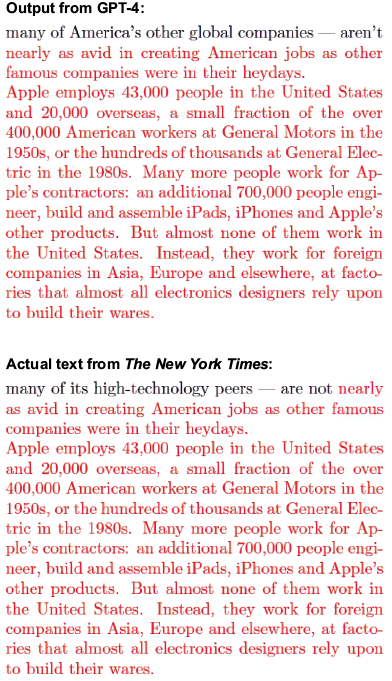
Compare the generated passage with the published wording to see what near-verbatim memorization looks like in practice. section 6.1



