Microservice architecture structures an application as independently evolvable services that communicate over a network. Services separate business concerns, establish contracts, and can be updated, scaled, replaced, scheduled, or debugged independently. This supports frequent delivery on distributed infrastructure rather than tightly coupled monolithic releases. section 1.1 section 16.0
A production microservice architecture trades monolithic simplicity for independent service operations:
- Decouple business logic into self-contained services so teams can accelerate development and optimize individual components. section 16.3
- Manage added configuration, deployment, maintenance, and dependency complexity across many environments. section 16.3
- Use automation and configuration as code to deploy the whole application consistently across public clouds and on-premises data centers. section 16.3
- Use a service mesh to resolve logical service dependencies, enforce security policy and mutual TLS, connect traditional VMs, and observe performance. section 16.3
- Prefer incremental modernization: containerize existing applications first, then refactor selected components instead of requiring a big-bang rewrite. section 15.3.4 section 16.6
Modernization path
A modern application can be containerized, integrated with CI/CD, and run on Anthos before further refactoring into microservices. A traditional Linux or Windows monolith can be containerized with Migrate for Anthos; applications requiring legacy drivers can move to bare metal or Google Cloud VMware Engine and be refactored later. section 15.3.4
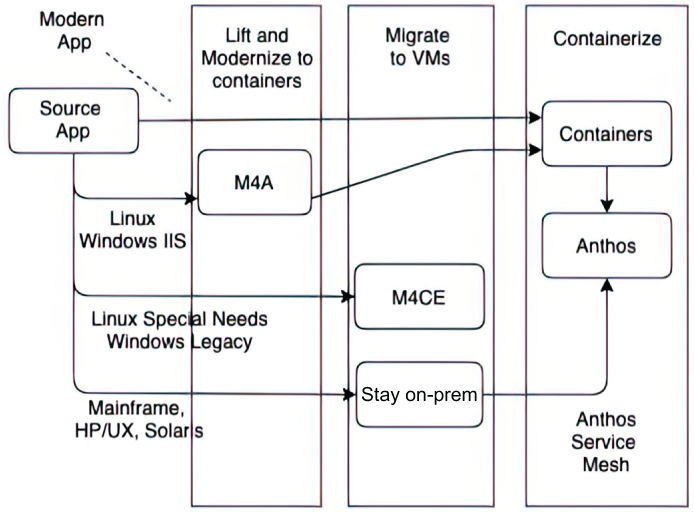
Use the modernization journey to compare containerization, Anthos deployment, direct VM migration, and later microservice refactoring. section 15.3.4













