liveBook · Manning

Microservice architecture

As explained in Software Security for Developers

A software architecture that decomposes an application into independently deployable services organized around business capabilities.

Microservice architecture decomposes an application into services organized around business capabilities. Each service exposes a user interface or API, contains its business logic, and can be deployed independently; any required database remains private to that service. section 3.1

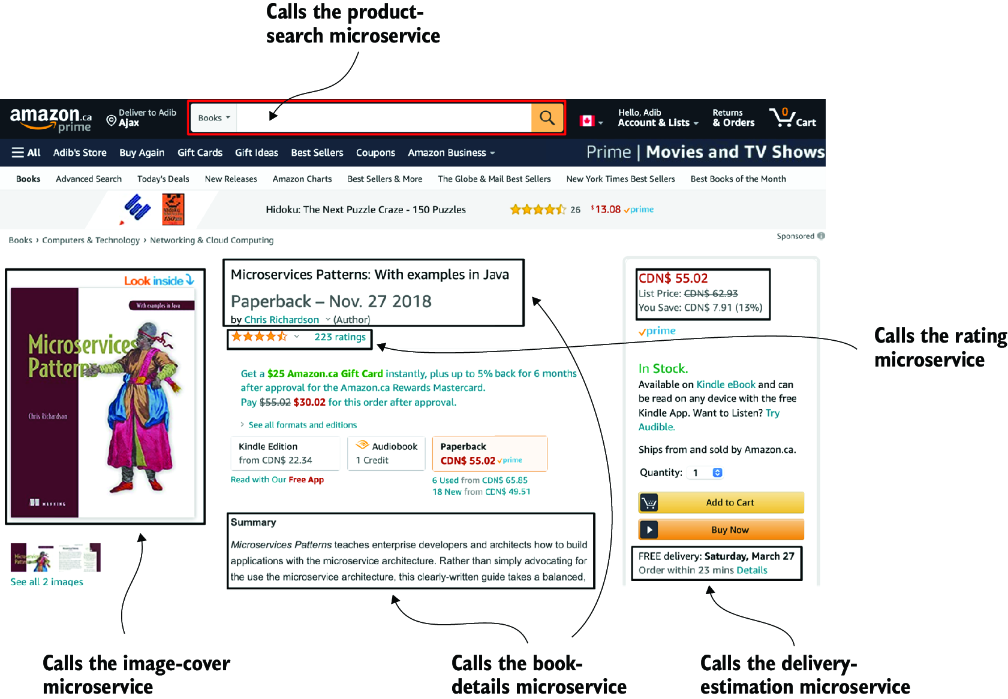
Figure 3.1 Potential microservices that can be spotted on a product page: product-search microservice, look-inside microservice, book-details microservice (title, author, publication date, and summary), product-rating microservice, pricing microservice that can calculate discounts dynamically, and delivery-estimation microservice that estimates when an order will arrive at a customer’s address and the shipping costs
figure

A product page can be divided into product-search, book-details, pricing, ratings, look-inside, and delivery-estimation microservices. section 3.1

Product page call chain

A product-page service calls book-details, pricing, and delivery-estimation services over HTTP. The request can fan out through multiple layers, creating a service-to-service call graph that must authenticate services and protect communication channels. section 3.1 section 3.0


How Software Security for Developers covers it

How deep it goes
Defines service boundaries and illustrates call-graph complexity, then focuses on communication security rather than deployment mechanics.
Examples
Uses an online product page with book-details, pricing, ratings, search, and delivery-estimation services.
What it assumes
Assumes familiarity with applications and APIs while introducing business capabilities, independently deployable services, and service-to-service calls.
What you can do after
Evaluate service boundaries and identify authentication and communication risks across a service-to-service call graph.
How it connects
Connects business capabilities, REST APIs, private databases, HTTP, service identity, API gateways, and service meshes.

Also explained in

Compare how 14 books explain microservice architecture →

Related concepts

This explainer was generated by Manning's knowledge graph from the text of Software Security for Developers. The section links point to the parts of the book it draws on.











