liveBook · Manning

Mind map

As explained in Functional Design and Architecture: Examples in Haskell

Mind mapping is a diagramming technique for organizing ideas and their relationships around a central topic.

A mind map is a tree-like diagram that organizes notions and their associative relationships around a concrete domain topic. It gives brainstorming more structure without imposing the rigidity of user stories or use case diagrams. section 2.1.4 section 2.1.5

Use mind maps to make requirements and domain knowledge easier to inspect:

  • Start with a focused part of the domain rather than attempting an exhaustive model. section 2.1.5
  • Expand large topics into progressively more detailed maps as understanding grows. section 2.1.5
  • Connect leaves and branches when relationships carry information beyond isolated notions. section 2.1.5
  • Choose notation personally; no standard format is required for recording associations. section 2.1.4

Generating a random world

A requirements map for a game can begin with the broad topic of world generation, then branch into seed selection, surface-to-ocean ratio, biome count, forest density, and other generation parameters. Further maps can elaborate individual topics while preserving navigation across the domain. section 2.1.4 section 2.1.5

Figure 2.10 Level 1 mind map
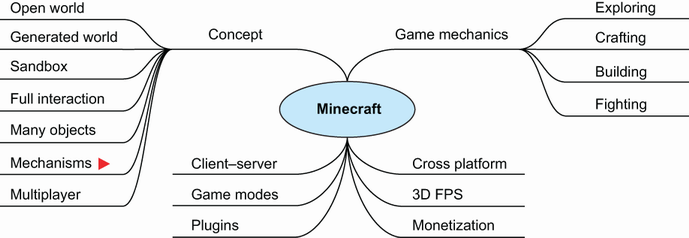
Browse the progressive mind-map views: a broad domain overview followed by increasingly detailed topic maps. section 2.1.5


How Functional Design and Architecture: Examples in Haskell covers it

How deep it goes
Defines trees, branches, leaves, associative relations, and adaptable granularity, but stops short of prescribing a formal notation.
Examples
Uses Minecraft domain maps, including broad game topics, world-generation parameters, and three levels of diagram detail.
What it assumes
Starts with brainstorming and assumes a need to understand the domain before constructing application architecture.
What you can do after
Apply it to investigate requirements, arrange domain knowledge, identify important terms, and navigate relationships across a product domain.
How it connects
Connects brainstorming, requirements analysis, user stories, use case diagrams, user scenarios, and software architecture.

Also explained in

Compare how 4 books explain mind map →

Related concepts

This explainer was generated by Manning's knowledge graph from the text of Functional Design and Architecture: Examples in Haskell. The section links point to the parts of the book it draws on.

