liveBook · Manning

Mind map

As explained in Writing for Developers: Blogs that get read

A nonlinear visual arrangement of a central topic and branching connected ideas.

A mind map visually connects a central topic to branching ideas. Use it when thoughts feel tangled: brainstorm and organize without forcing a beginning-to-end sequence. section 4.3.2

Build one quickly:

  • Place the main topic on a page or screen. section 4.3.2
  • Branch outward with related ideas in any direction; do not worry about logical order. section 4.3.2
  • Turn the result into an outline, start writing directly, or leave placeholders for later. section 4.3.2 section 4.8

Zig data migrator

A mind map for a Zig data migrator blog post can branch into topics such as the migrator’s components and leave the Zig branch undeveloped until later. section 4.3.2

Figure 4.2 Mindmaps might seem awkward, but some people find them helpful.
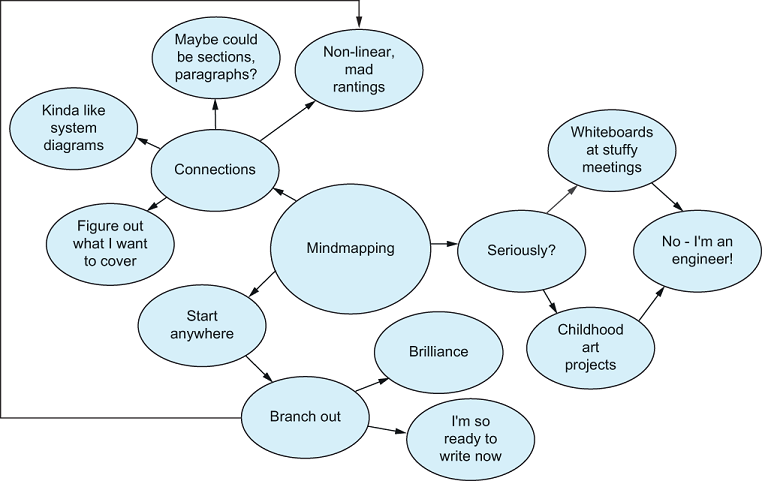
Inspect the figure for a visual model of a mind map’s connected, branching structure. section 4.3.2


How Writing for Developers: Blogs that get read covers it

How deep it goes
Explains central branching, nonlinear flow, follow-up outlining, and tool choice, but offers no formal notation.
Examples
Uses a Zig data migrator blog-post map and compares digital tools with pen and paper.
What it assumes
Assumes only a topic and tolerates awkwardness; teaches the practice without requiring specialized software.
What you can do after
Apply it to generate connected ideas, then organize them into an outline or draft.
How it connects
Connects brainstorming, outlining, writing, and system architecture diagrams.

Also explained in

Compare how 4 books explain mind map →

Related concepts

This explainer was generated by Manning's knowledge graph from the text of Writing for Developers: Blogs that get read. The section links point to the parts of the book it draws on.

