liveBook · Manning

Mode collapse

As explained in Generative AI in Action

Mode collapse is a generative-model failure in which the model produces a narrow range of outputs repeatedly instead of representing the diversity of the data distribution.

Mode collapse is a generative-model failure where a generator repeatedly produces a narrow range of outputs, ignoring parts of the data distribution. In image generation, this limits diversity even when individual outputs appear realistic. section 4.1.2 section 4.1.4

Mode collapse matters because it can:

  • Reduce the diversity of generated images and weaken applications such as synthetic data generation or data augmentation. section 4.1.2
  • Make a GAN reproduce the same output repeatedly rather than represent the full range of the training distribution. section 4.1.4
  • Provide a reason to consider diffusion models, which are described as avoiding this problem while capturing broader distributional diversity. section 4.1.4

Synthetic image generation

A GAN intended to create varied training images may repeatedly generate nearly the same image or pattern. Those outputs can look high-quality while failing to supply the edge cases or diversity needed for augmentation. section 4.1.2

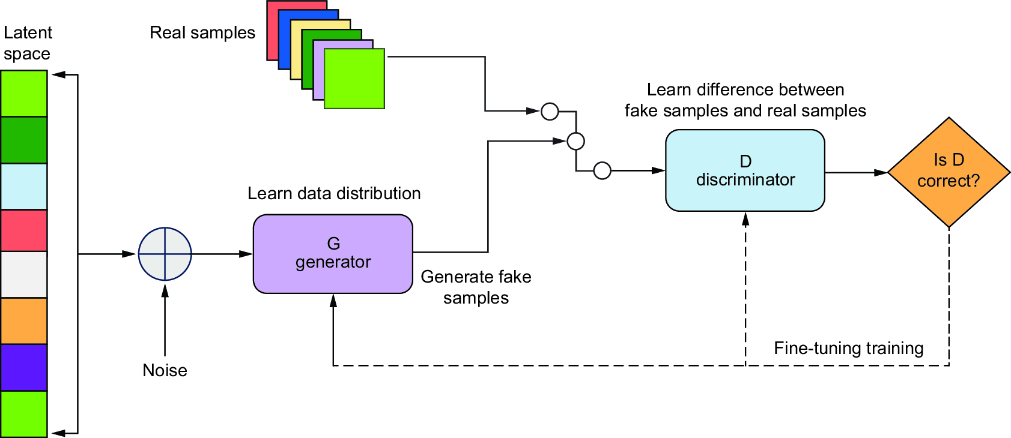
Figure 4.5 GAN model architecture
figure

Inspect the GAN model architecture to connect the generator’s role with the failure mode of repeatedly producing the same output. section 4.1.2

How Generative AI in Action covers it

How deep it goes
Defines the failure and contrasts it with diffusion models, but does not explain training dynamics or mitigation techniques.
Examples
Uses repeatedly generated images and reduced diversity in synthetic training data as concrete examples.
What it assumes
Assumes basic familiarity with GANs, generators, images, and data distributions while defining mode collapse directly.
What you can do after
Evaluate whether limited output variety makes a GAN unsuitable for diverse image generation or data augmentation.
How it connects
Connects mode collapse to GANs, generators, data distributions, image generation, data augmentation, and diffusion models.

Also explained in

Compare how 4 books explain mode collapse →

Related concepts

This explainer was generated by Manning's knowledge graph from the text of Generative AI in Action. The section links point to the parts of the book it draws on.

