Quantization stores model numbers with fewer bits. Think of it as rounding calculations to save space: the answer changes slightly, but usually not enough to ruin the image. section 10.1.3
The practical payoff is lower VRAM use. A model that normally stores each number in 16 bits can use an 8-bit version instead, making large models such as Flux easier to run on constrained hardware. section 9.2.1 section 10.1.3
A practical loading workflow looks like this:
- Open the Load Diffusion Model node and choose the model file through its unet_name field. section 10.1.3
- Choose a quantized file such as flux1-dev-fp8.safetensors when the full-precision model exceeds available hardware resources. section 10.1.3
- Leave weight_dtype at default unless the workflow requires another setting; quantization is already reflected in the selected model file. section 10.1.3
The rounding trade-off
Multiplying 3.14159 by 2.71828 gives a more precise result than multiplying 3.14 by 2.72, but the shorter version saves digits and produces a nearby answer. Quantized model weights apply the same basic compromise at scale. section 10.1.3
Figure 10.5 Using the fp8 model only minorly impacts the quality of our output.
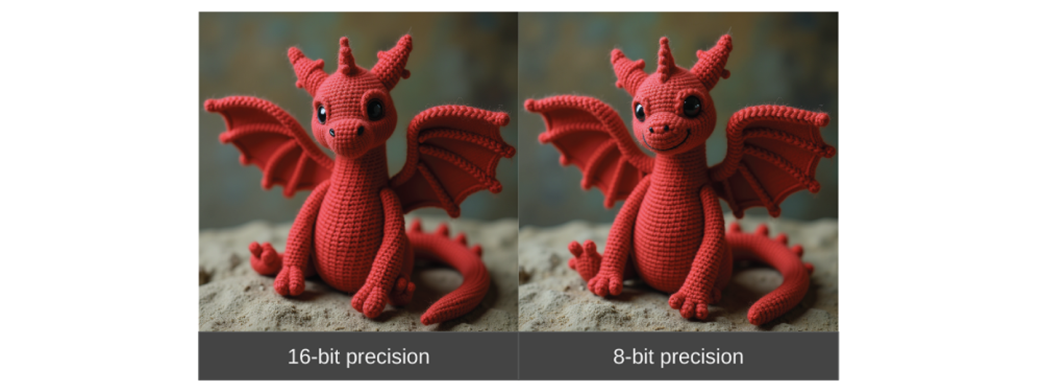
Compare the full and fp8 outputs to see the usual bargain: substantially easier model loading with only a minor visible quality impact. section 10.1.3





















