Quantization converts continuous or floating-point values into discrete buckets or integer-aligned indices. In feature extraction, it makes RoI pooling regions executable on a discrete feature map. section 5.6 section 11.4.3
The treatment uses quantization in two related ways:
- Discretize random variables by assigning ranges such as weight or height intervals to buckets and estimating each bucket’s probability. section 5.4.2
- Convert floating-point RoI-to-bin ratios into integer region sizes, using the closest integer or floor operation in the original implementation. section 11.4.3
- Preserve a fixed output shape while allowing the input RoI and pooling-region size to vary. section 11.4.3
Quantizing an RoI for pooling
If a feature-map RoI has height 8 and the target pooling grid has four rows, each region is 8/4 = 2 feature-map units. When the ratio is fractional, quantization selects an integer size; RoIAlign instead uses bilinear interpolation. section 11.4.3
Figure 11.18 A conv feature map with two regions of interest of different sizes. RoI pooling extracts a fixed-sized output feature map (2 × 2 in this image) from each of the RoIs in a single pass via max pooling. This enables us to extract fixed-sized representative feature vectors for each RoI, which are then fed into further classifier and regressor layers for classification and localization.
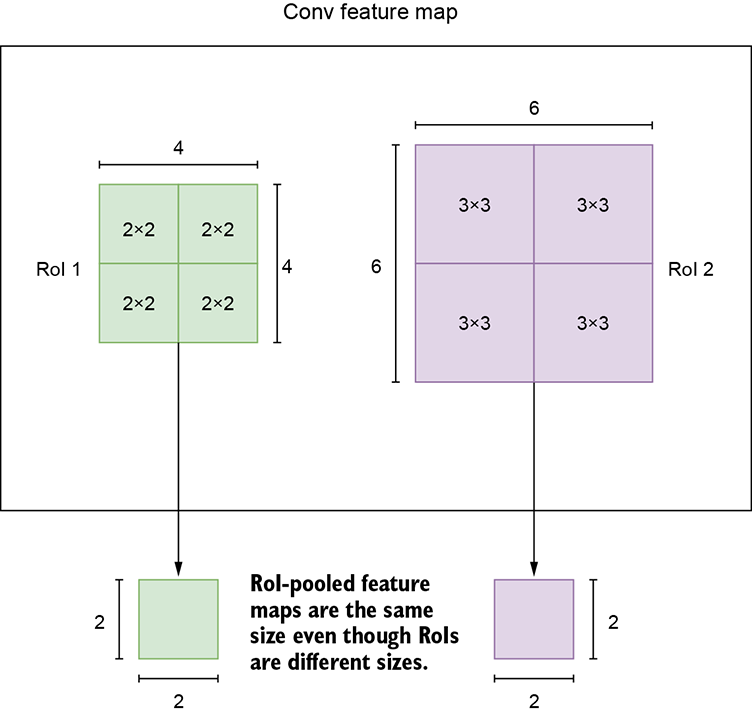
Compare differently sized RoIs producing fixed-sized pooled feature maps through max pooling. section 11.4.3