Quantization maps continuous real values to a finite set of discrete levels. In time-series forecasting, it converts scaled observations into tokens that a language model can process. section 5.3 section 5.2
A Chronos-style quantization pipeline proceeds as follows:
- Mean-scale each point, then assign the resulting value to a uniformly spaced bin. section 5.3
- Clip scaled values between -15 and 15 and use 4,094 bins to create the token vocabulary. section 5.3
- Accept reduced precision: values within one bin become indistinguishable to the language model. section 5.3
- Reverse the transformation during prediction by dequantizing and unscaling generated tokens. section 5.2
Figure 5.5 Effect of the number of bins on the resulting tokens. In the top plot, we have a vocabulary of 100 possible bins, and in the bottom plot, we use only 5 bins. With 5 bins, we lose too much precision.
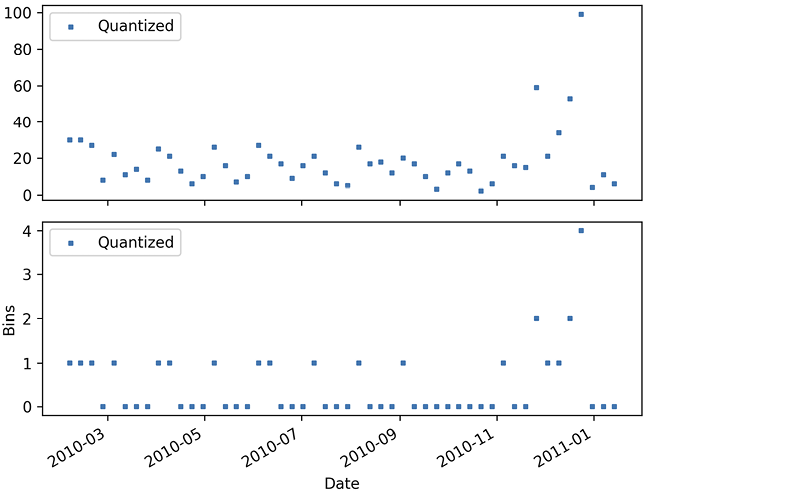
Compare how the number of bins controls token precision: too few bins erase important variation. section 5.3












