A modernization initiative turns aging software and architecture from a business liability into capabilities that better serve customers and the organization. Slow change, costly maintenance, and unreliability can weaken competitiveness, but replacing technology alone is not enough. Modernization can also reshape user experience, products, business processes, domain models, and how teams work together. section 1.0 section 1.3 section 8.0
The business risk behind an old system
Southwest Airlines’ decades-old scheduling system contributed to a 2022 crisis in which 14,500 flights were canceled in one week. The case illustrates why architecture health matters beyond an engineering department: system reliability can affect customers, operations, and reputation. section 1.0
Start with the outcome, not a fashionable pattern. Ask whether the business needs faster innovation, lower operating costs, greater scalability, better reliability, or improved user experience. Then identify which products and parts of the architecture matter most to those goals. A change that is valuable in one subdomain may be unnecessary expense in another. Microservices, for example, are one possible socio-technical choice—not a default destination. section 3.0 section 1.3 section 1.1
A visible UX problem with deeper causes
A rental-car website told a customer to retry payment after its backend reported an error, although a booking had succeeded; the customer unintentionally made three bookings. A website redesign alone would not address that kind of architectural cause. Diagnose where a user-facing failure begins before deciding what to modernize. section 3.1.5
Treat planning as a collaborative, revisable activity:
- Agree on business and product outcomes, and ask stakeholders what threats or constraints they consider most important. section 3.0 section 3.1
- Examine the existing domain, processes, user needs, and technical debt. Identify what should improve, what needs new capabilities, and what no longer needs to exist. section 3.0 section 8.0
- Choose investment and sequencing by subdomain rather than committing every area to the same rewrite. Keep discovery, architecture design, and delivery moving in parallel; use feedback to revise the roadmap. section 1.3
- Make room for the work. Leadership must discuss short-term feature-delivery trade-offs, share responsibilities across levels, and fund continuing learning. section 2.1.1 section 2.1.5 section 2.5
Figure 1.11 Architecture modernization is parallel streams of work (not phases) supported by continuous learning and upskilling.
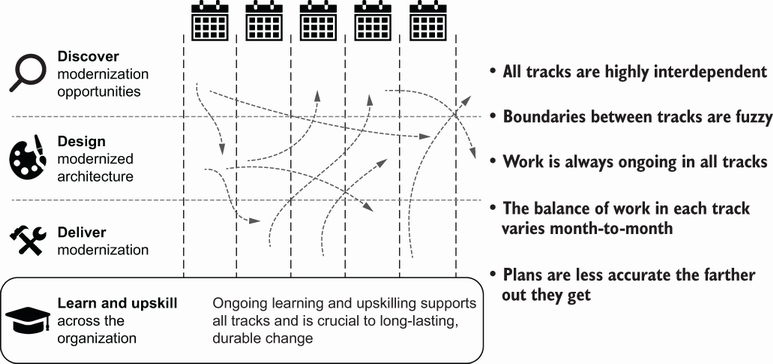
Use the parallel-streams diagram to discuss how discovery, design, delivery, and learning can influence one another without becoming rigid sequential phases. section 1.3
Expect a journey rather than a quick fix or a fixed target-state project. Meaningful value can begin before every part of the organization has been mapped or redesigned. Continue testing whether each change advances the intended business outcome, and adjust the next investment accordingly. section 1.3 section 2.4



