A monolithic architecture deploys most or all application functionality as one unit. It is not automatically a scaling failure: a self-contained, computationally intensive workload can benefit from consolidation, while many independently owned capabilities may favor decomposition. section 5.3.1
Choose the deployment shape from operating constraints:
- Consolidate when orchestration and data-transfer overhead dominate a self-contained workload; one video-stream analysis system reduced infrastructure costs by 90% after moving into a single process. section 5.3.1
- Decompose when distinct capabilities need different scaling behavior and independent team deployments; Netflix migrated after a monolithic database-corruption outage. section 5.3.1
- Modularize rather than split when a shared codebase remains workable; GitHub’s Ruby on Rails monolith supports over 100 million developers with more than 1,000 engineers collaborating. section 5.3.1
Figure 5.6 Monolith vs microservices latency
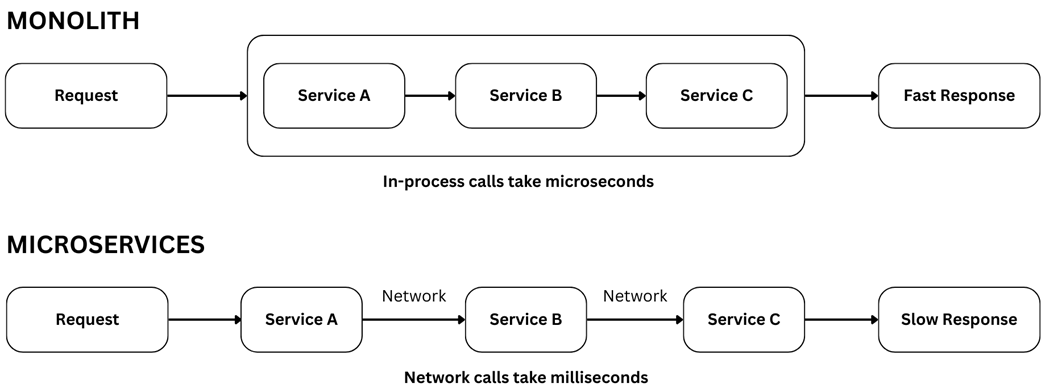
Compare the latency trade-off between a monolith and microservices deployment. section 5.3.1












