An MPLS Layer 2 VPN makes the provider network transparent to customer edge (CE) routers. The provider behaves like a giant switch, forwarding customer frames between sites while MPLS labels isolate each customer’s traffic on shared infrastructure. section 16.1.2 section 16.4
Core operational distinctions include:
- CE routers send and receive regular IP packets and do not participate directly in MPLS. section 16.1.2
- Provider edge (PE) routers connect to customer networks and assign or remove MPLS labels; provider (P) routers forward labeled packets internally. section 16.4
- Customer CE routers form dynamic routing-protocol neighbor relationships with one another across the L2VPN. section 16.1.2
- Overlapping private address ranges can coexist because each customer VPN remains isolated. section 16.1.2
- Unlike an L2VPN, an L3VPN has PE routers participate directly in routing with CE routers. section 16.4
Routing across a transparent provider
Customer A can run OSPF between CE routers at two sites, while Customer B runs EIGRP. The MPLS L2VPN forwards those routing messages as frames, allowing both customers to use the same private 10.0.0.0/30 subnet without conflict. section 16.1.2
Figure 16.5 Two customers connect their remote sites using a service provider’s MPLS L2VPN service. PE and P routers are not shown.
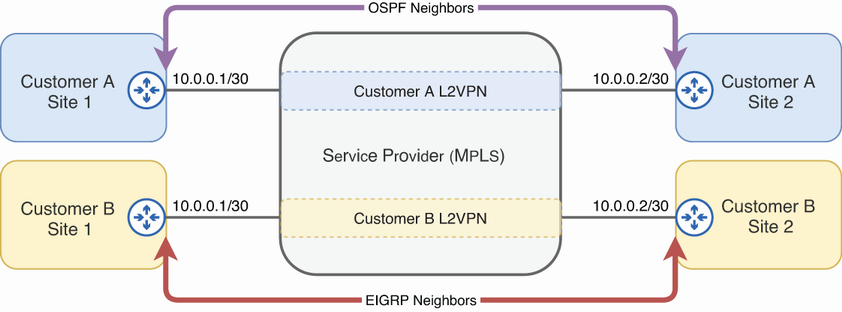
Use the topology figure to inspect how two customers connect remote sites through an MPLS L2VPN and how the provider routers remain outside the customer routing relationships. section 16.1.2
