An MPLS Layer 3 VPN lets a service provider actively participate in customer routing while keeping customers’ traffic separated across shared MPLS infrastructure. section 16.4
Understand the device roles and routing behavior:
- CE routers send and receive regular IP packets and do not actively participate in MPLS. section 16.1.2
- PE routers sit at the provider edge, connect to customer networks, assign and remove labels, and form dynamic routing neighbors with CE routers. section 16.4
- P routers remain inside the provider network and forward labeled packets without directly connecting to customer networks. section 16.4
- Unlike an L2VPN, where the provider behaves like a transparent switch and CE routers peer with one another, an L3VPN has CE-to-PE routing relationships. section 16.4
Figure 16.6 Two customers connect their remote sites using a service provider’s MPLS L3VPN service. CE routers form dynamic routing protocol neighbor relationships with PE routers.
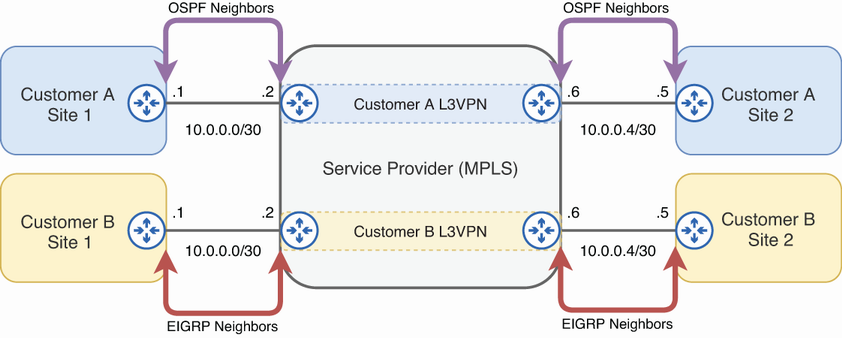
Use the topology to trace how CE routers form dynamic routing protocol neighbor relationships with PE routers across an MPLS L3VPN service. section 16.1.2
MPLS labels provide isolation between customer VPNs even though they share the same provider infrastructure; the implementation differs from an MPLS L2VPN. section 16.1.2 section 16.4
