A multilayer perceptron (MLP) is a feed-forward neural network with fully connected hidden layers between its input and output. It transforms an input vector through successive linear layers and activations to produce a prediction. In graph workflows, an MLP provides a non-GNN baseline: each node becomes one tabular observation containing node features, while graph structure and geometry are ignored. section 4.3 section 2.4.4
A practical PyTorch MLP follows this pipeline:
- Define the network as a class with an input size, hidden-layer widths, and output size. section 4.3.1
- Pass the input through linear layers, applying ReLU after hidden layers and sigmoid at the output for binary prediction. section 4.3.1
- Train with binary cross-entropy and evaluate predictions using accuracy-oriented metrics such as ROC and AUC. section 4.3 section 4.3.1
Node-classification baseline
A three-layer PyTorch MLP uses two hidden layers with widths 128 and 256, followed by a one-output layer. Trained for 100 epochs, it reaches 85.93% ROC AUC, performing between logistic regression and XGBoost on the same node-feature data. section 4.3.1
Figure 2.14 Structure of a multilayer perceptron
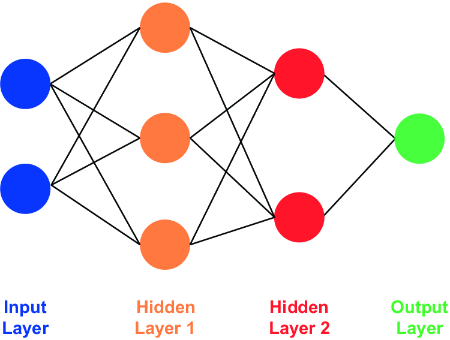
Use the architecture diagram to inspect how an input vector flows through hidden layers toward an output. section 2.4.4

