A multi-tier application places components between clients and the services that fulfill their requests. In a RESTful web API, intermediary HTTP services or filters can improve security, performance, and scalability. section 1.1.4
Consider a board-game API that handles incoming HTTP requests and data exchange while a database management system (DBMS) provides the data. The API and DBMS can run on different servers. Adding a reverse proxy and a content delivery network (CDN) places two more layers between clients and the API server. section 3.1.4
Each added layer has a practical job:
- A reverse proxy can cache responses and support load-balancing techniques that improve horizontal scalability. section 3.1.4
- A CDN adds caching, reduces latency across regions, and can lower server bandwidth use. section 3.1.4
This is an architectural plan, not a completed deployment: implementing the reverse proxy and CDN is deferred until production deployment. section 3.1.4
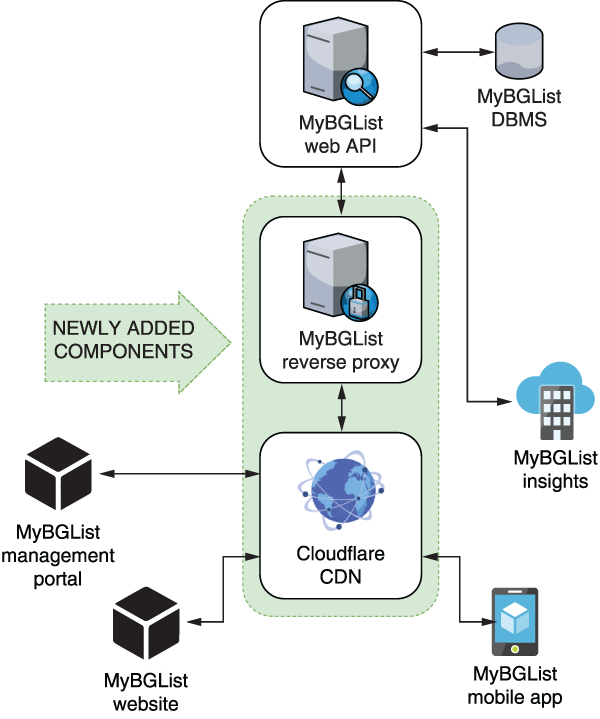
The architecture diagram places the CDN and reverse proxy between clients and the board-game API within the wider service-oriented system. section 3.1.4






