A neighborhood topology defines which particles in a particle swarm communicate and share successful positions. Its social structure influences convergence speed and the risk of getting trapped in local minima. section 9.2.4
Common PSO topologies make different exploration–convergence trade-offs:
- Star, or global best (gbest), connects every particle to the entire swarm. It usually converges quickly and suits unimodal problems, but can lose exploration and become trapped in local minima. section 9.2.4
- Ring, or local best (lbest), lets each particle communicate with adjacent neighbors. It converges more slowly but explores more of the search space and is recommended for multimodal problems. section 9.2.4
- The Von Neumann model arranges particles in a grid, connecting each particle with neighbors above, below, left, and right. section 9.2.4
- The wheel topology is identified as another common PSO neighborhood structure. section 9.2.4
Figure 9.5 PSO neighborhood topologies: a) the star social structure, b) the ring topology, c) the Von Neumann model, and d) the wheel topology
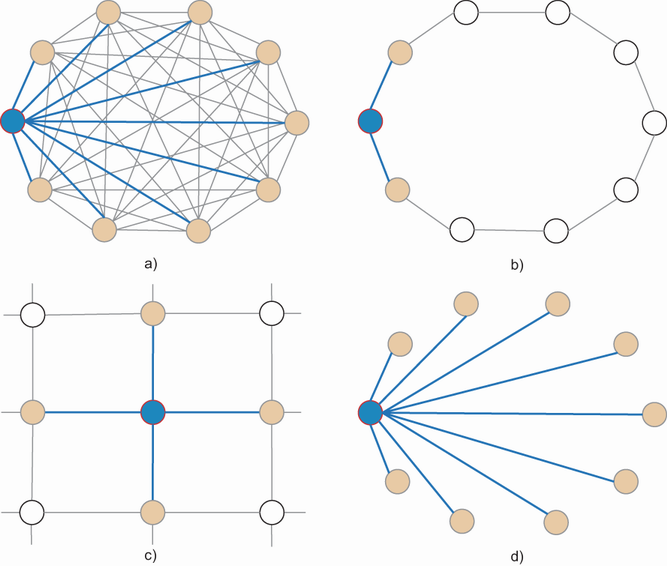
Compare the star, ring, Von Neumann, and wheel connection patterns visually before selecting a swarm communication structure. section 9.2.4
