A factual condition is an observed fact, event, or piece of evidence that narrows the population under discussion. In P(Y | X = x), the factual condition appears after the vertical bar and filters attention to cases where X actually equals x. section 8.2.2
Keep factual conditions distinct from hypothetical conditions:
- A factual query asks what Y is for cases where X = x: P(Y | X = x). section 8.2.3
- A hypothetical query asks what Y would be if X were set to x, regardless of its observed causes. section 8.2.3
- The two can combine: ask a hypothetical question about a population already filtered by a factual condition. section 8.2.3
Game-player example
“What would in-game purchases be for players with high side-quest engagement?” uses high engagement as a factual condition. A counterfactual instead asks what purchases would be if engagement were high for a player whose observed engagement was low; the low engagement remains the factual condition. section 8.2.2 section 8.2.4
Factual and hypothetical conditions may conflict, producing a counterfactual query. When they agree, the consistency rule removes the redundant hypothetical condition: P(YX=x | X=x, Z=z) = P(Y | X=x, Z=z). section 8.2.4 section 8.2.5
Figure 8.4 Elements of a conditional counterfactual hypothetical formalized in counterfactual notation
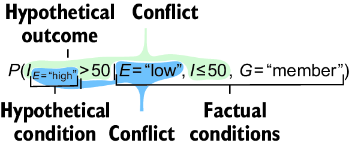
Use the notation diagram to locate factual conditions and distinguish them from hypothetical conditions in conditional counterfactual queries. section 8.2.4
