The Common Language Runtime (CLR) is the execution environment shared by .NET languages. The modern .NET runtime is called CoreCLR; the original .NET Framework runtime was called CLR. C#, F#, and Visual Basic compilers produce Common Intermediate Language (CIL), which CoreCLR can execute. The runtime also provides memory management. section 1.1 section 1.5
A language compiler places CIL in a DLL. Because CIL does not target a particular processor, that DLL can run on another supported operating system or processor when a .NET runtime is available. CoreCLR normally uses just-in-time (JIT) compilation to turn CIL into machine code as the application needs it, rather than compiling the entire application at startup. section 1.5.1 section 1.5.2
For a known deployment target, such as a Docker container, ahead-of-time (AOT) compilation can reduce the initial wait for JIT compilation. AOT can also trim unused code, but trimming needs thorough testing because it may remove too much. The runtime’s other major concern, garbage collection, is introduced alongside CIL and JIT rather than detailed here. section 1.5.2 section 1.5
Figure 1.4 .NET languages compile to CIL in a DLL file that can be run on any machine with a .NET runtime.
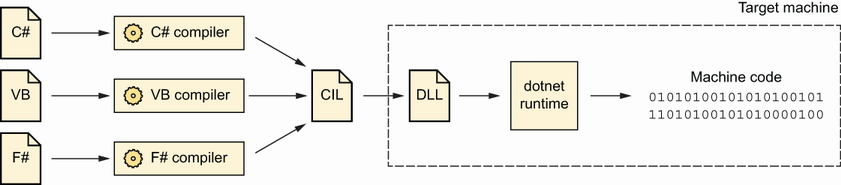
Trace a .NET language from compilation into a CIL DLL, then through the runtime on the machine that executes it. section 1.5.1


