A network is the communication infrastructure through which concurrent components send and receive messages. It has its own local state, including messages in flight, while each component retains exclusive access to its own local state. section 1.0 section 1.4
A useful mental model treats the network as a participant in system behavior. Components and the network take discrete steps: components perform local computation or send and receive messages, while the network may carry, delay, or fail to forward a message. A component sees only its own state and its channel to the network, not the system’s complete state. section 1.4 section 1.5.2
Distributed Systems Incorporated
Imagine an office whose rooms represent components and whose pneumatic tubes represent the network. A room sends a message into the tubes addressed to another room, but the mailroom may lose, duplicate, or reorder it. The analogy makes message delivery and network failures concrete without treating components as directly connected. section 1.6 section 1.5.2
Figure 8.5 The network as point-to-point communication links between components
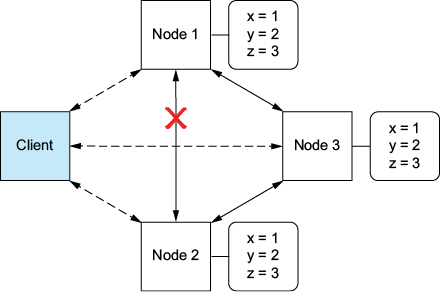
Use the point-to-point network view to visualize communication links and network partitions between components. section 8.4.1
Network behavior shapes correctness, scalability, and reliability. In replication, message loss is modeled as a temporary, intermediate, or permanent failure of one or more communication links, producing a network partition. section 1.9 section 8.4.1


